logo

Drop us a Line

info@themusictherapycenter.com

music therapy Tag

Communication is vital to living in this world. We rely on each other when there are things we can’t do on our own. For those who cannot vocalize their needs or have delays in speaking – this can be frustrating not only for them but also for their caregivers and loved ones. 

Enter Proloquo2go – Proloquo2go is an AAC (Augmentative and Alternative communication) app created to assist teachers, therapists, and caregivers to help those who cannot vocalize their needs. The format consists of icons on a grid that allow the user to set up certain “words” or “phrases” that they can touch to help “voice” what they want. As music therapists, we can use this platform to provide an opportunity for clients to express their needs and wants such as preferred songs or instruments they enjoy. It can also be used to enrich a session by providing words/phrases/pictures that may be difficult for the client to express otherwise. Giving them a voice to communicate and make choices can be motivating for them in sessions and to generalize this skill outside of music.

Image courtesy of Assistive Ware https://aaccommunity.net/2018/01/starting-out-with-proloquo2go/ 

It is important to remember that while apps like these can be very helpful in assisting with verbal communication – they are not a replacement for helping to learn body language, social cues, and other forms of non-verbal communication. However, by providing an opportunity to communicate needs and meet the person where they’re at verbally we can create an environment ripe for growth, development, and communication. In music therapy sessions, we can use these as intraverbals (call and response) or requests for songs they would like to hear. There is never a bad opportunity to encourage communication. 

According to the website Proloquo2go is $249.99 on the US Apple store (currently unavailable on android). However there is a discount for schools if 20 or more copies are purchased. For more information visit: https://www.assistiveware.com/products/proloquo2go. If purchasing Proloquo2go is not an option due to financial reasons or perhaps the parents or school do not want to pay for it, there are much lower costing alternative options such as PECs boards (Picture exchange communication system). 

Here is an example!: https://www.storyboardthat.com/articles/e/pecs-boards

These resources are relatively easy to put together and just as customizable as Proloquo2go although you will not get a voice reading the words if it is a physical copy rather than a digital one.

Sources: 

Proloquo2Go – AAC app with symbols 

https://www.assistiveware.com/products/proloquo2go

Eric Amparo, Music Therapy Intern

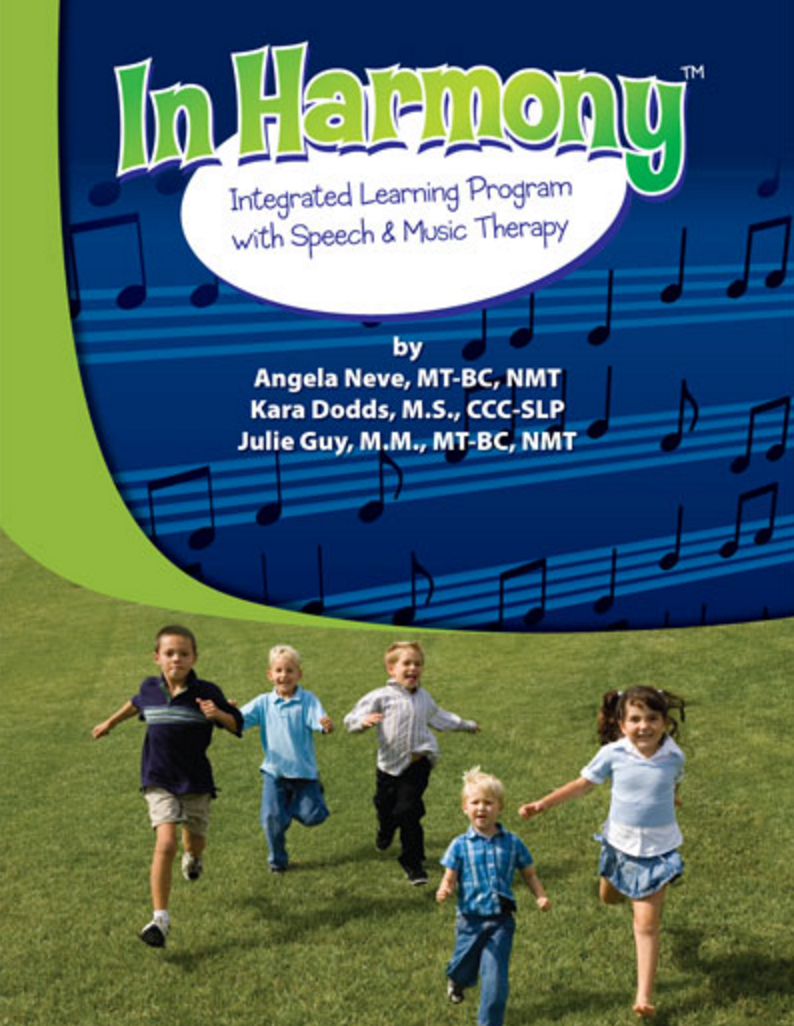
I recently had the opportunity of attending a training webinar on using music for coping strategies. Julie Guy and Angela Neve used a song from their integrated learning program, In Harmony. In Harmony combines specialties of music and speech therapy in order to teach kids essential life skills (social, academic, daily living, etc.). One of the primary takeaways from their webinar was their structured protocol for each lesson:

  1. Interact and learn – Learn the song with visuals or hand-motions to help.
  2. Pause for understanding – Review the song.  Try using the karaoke track for practicing the lyrics.
  3. Fade the music – Pull back the music to transition from singing to speech.
  4. Generalize – Generalize the lesson and apply it to practical situations in everyday life.

I think these steps are a helpful framework for how to use these songs at home. It is important to make music lessons interactive. I am a kinesthetic learner, so the best way for me to learn is by interacting with a concept physically. Another helpful way to retain new information is by applying it to your own life. For instance, when you are using music to learn new coping strategies, consider a moment when you could have used a coping strategy.  Use it as an example in the song! When the situation comes up again, sing the song. Even simply reciting the lyrics can be grounding.

In Harmony is an amazing resource including 60 page full-color digital program manual, 24 audio files and 120 color-coded digital photo flashcards. Printable chord charts and instrumental tracks allow the program to be adapted and customized to individualized needs. The In Harmony Integrated Learning program is available for purchase on MTCCA’s website. Additionally, individualized learning packs are available teaching skills such as brushing teeth, sharing our things, and starting conversations.

Join us for the rest of our series! Our next topic is “Daily Living” on April 19th. Anyone interested in learning about using music to teach children essential life skills is welcome to attend. Register here for free! Or attend a 2-hour In Harmony Music Strategies workshop sponsored by our friends at Autism Tree Project Foundation on April 29th for a $10 donation to their organization.

ATPF In Harmony Workshop Flyer

Learn more about teaching social skills through song here!

-Emma

Hello everyone!

It is hard to believe that my time at internship is quickly coming to an end! I know everyone says that internship is the time where you learn and grow as a music therapist more than you ever thought you could, and it is absolutely true! I feel more confident than ever that I have learned the skills and gained the experience needed for me to be sent out into the real world. This blog post is to share some of my top learnings during internship!

1. You ARE capable

Confidence was one of the biggest things missing from my toolbox of strengths when I first entered internship. I felt that I had the academic knowledge enough to set myself up for success, but still felt inadequate and scared to facilitate in front of large groups of clients, singing unfamiliar songs, etc. However, internship really forced me to push myself out of my comfort zone and try new things. I am not sure when it happened, but I realized at some point into my internship, I could confidently and comfortably get up in front of a group of 40 clients and not think twice about it. I was entirely focused on my facilitation skills and client responses, which is exactly where I needed to be. Which brings me to my point: You can do it!!! 

2. The power of the EZ-220 

The EZ-220. Absolutely life changing. For those of you who do not know, the EZ-220 is an electronic keyboard from Yamaha that has many useful features for sessions. We use it for almost every group session that we have, as it is fairly accessible and portable. The feature that I use most are the backbeats, which can help with engagement, attention, and helping to make the music that you facilitate sound more full. There are different styles of backbeats, including 8 and 16 beat, swing, ballad, rock, and much more! There are also different voices on the keyboard, such as wind and string instruments, and the standard drum kit which we often use in sessions, and a great “follow the lights” feature as well. AND, the EZ-220 is also equipped with many pre-recorded songs! The keyboard can also be plugged into an amp to project more sound. I would absolutely recommend investing in one if you facilitate a lot of group sessions, here is a link to where you can find one! 

3. Using themed sessions!

I have previously written a blog post about this which can be found here! But just to reiterate again, using themes can help center your session, provide reality orientation, and can help you gain inspiration and avoid ruts when session planning.

4. Visuals, visuals, visuals!

During practicum in college, I would frequently use visuals for my younger clients and groups, but I never thought to use them for other groups. Now, I don’t go a session without them! Visuals are a really important tool to engage clients, especially to provide an outlet for communication for non-verbal clients. For example, for my older adult sessions, I will put on background music with a specific theme (using Auld Lang Syne during New Years themed sessions), and go around and show photos on my iPad with different new years related objects (the ball in NYC, fireworks), and engage in conversation with the residents. These visuals are especially helpful if there is a language barrier as well. I also use visuals a lot with my groups of adults with intellectual and developmental disabilities, as it helps explain concepts and engage their attention. 

5. Incorporating your primary instrument

If you’re like me, if your primary instrument isn’t voice, it was almost unheard of of using your primary instrument during sessions in college. It was one of my biggest goals to be able to learn how to incorporate it during internship- and it happened! I I use my clarinet all the time in older adult groups and with my adults with intellectual and developmental disabilities! For example, I will use my clarinet during name that tune, to help enunciate melodic patterns for PSE interventions, and if I am co leading with another therapist, I’ll provide harmonies or play the melody. We also frequently have drum circles, so I will facilitate call and response on clarinet and use non verbal musical cueing using it as well. 

6. EZ Play music is your best friend!!!  

If you haven’t heard of EZ play music, it is basically blown up music of just the melody with the notes written in the note heads, and it has the chords written above it. This has been extremely helpful when facilitating songs with older adults, because you are able to play an accompaniment pattern in your left hand while playing the melody in your right hand and singing. This really adds more musical depth, and also helps our residents hear the song more clearly. EZ play books are also really helpful to find more repertoire, as the books are classified by different themes (music from different decades, love ballads, college fight songs, musicals, and much more!) These books are published by Hal Leonard and a link to an example of one on Amazon can be found here! 

7. Take advantage of this time to learn and implement unique instruments

If you had told me 6 months ago that I would be therapeutically using the kazoo during my sessions, I would have never believed you! Along with the kazoo, autoharp is your best friend during PSE interventions as well. I was also recently inspired to purchase a mandolin which I will be implementing in future sessions 🙂 

8. Take the time to address sensory needs for your clients

Before internship, I thought that if you did not facilitate music therapy the entire session or the majority of the session, then it was a failed session. However, now I know that sometimes the most important thing you can do for your clients is to provide them proper sensory stimulation and input so that they can be successful for their next task or the rest of their day. Sensory input techniques can include deep pressure squeezes, using a body roller, spinning in a chair, bubbles and more. 

9. Don’t be afraid of hand over hand assistance!!!

I never really had to touch any of my clients during practicum in undergraduate, and I also thought it was frowned upon. During internship, I learned how to provide effective hand over hand assistance, especially when it comes to older adults and adults with intellectual and developmental disabilities. Hand over hand is especially useful because it provides extra prompting and can help wake up clients if they are sleepy. 

10. Use your internship team as a resource!

Your internship directors, supervisors and music therapists are all there to support you! They are rooting for you and want the best for you. If you ever need help coming up with an intervention or are looking for a specific visual, chances are, someone on your team can help you! Don’t be afraid to ask questions- these people are your best resource and your colleagues for life 🙂 

There you have it- my top 10 learnings from internship! I would love to hear yours if you have completed yours or are getting close to, feel free to comment below! Thank you for reading my posts in the past 6 months! 


  • Juliana Hsu, MTI

Hello everyone, welcome to another blog post! 

This time of the year is so wonderful because you have the opportunity to do many winter and holiday themed interventions and sessions! I have talked about this a bit before in a previous blog post, but themed sessions that correlate with the time of the year is a great way to implement reality orientation with your clients. Since we live in San Diego and a lot of our clients have never experienced snow either, it is also another great way to teach them about different winter activities and what snow looks like! 

Today, I’ll be sharing some of my favorite winter/holiday themed interventions that we have facilitated over the past few weeks in December. I’ll also share the goals that you can target with these interventions as well.

  1. Build a Snowman

This is an intervention that you can use with both individual and group clients! I use this intervention for attention and listening goals. I printed, cut out and laminated various parts of a snowman, and used three 8×11” pieces of paper as a snowman’s body. For groups, I pass out different parts of the snowman, and within the song, different parts are called, and the client is supposed to hold up the correlating part of the snowman, and then they’re able to put it on the snowman. The parts are held on with velcro, so that they are able to easily detach and reattach. You can do the same thing with an individual client, but have the various parts of the snowman spread out, and then they find the correct part. I have attached a lead sheet of an adapted version of “Frosty the Snowman” that I wrote, along with a picture of my visual after a group of my clients completed this intervention 🙂 


  1. 12 Days of Christmas (piggybacked)

This is another intervention that I have created for my groups of clients that also focus on attention, sequencing and listening goals. I took the melody from the 12 Days of Christmas and changed it to the “10 Days of Winter”, and changed the lyrics so that each day is a different winter related object. Some objects I included are mittens, hot cocoa, fireplaces, snowmen, etc. I printed out photos of each object called, with one taking up an entire 8×11” sheet of paper, and then I pass them out to the clients. I explain that during the song, when their objects are called, they are to hold up the picture. This works great with bigger groups as well, because even if they do not have a picture, I prompt them to point at the picture of the object that is called. For example, when I sing “On the fifth day of winter, [facility name] gave to me, 5 snowflakes!”, the person with the picture of 5 snowflakes holds up their paper, and everyone else gets to point at the picture. 


  1. Holiday song fill in the blank 

Holiday songs can be a really great tool to use to help facilitate speech and work long-term memory because a lot of the songs are familiar to most clients. If you are familiar with the NMT technique called MUSTIM, this is a great technique to help facilitate both of these goals. You can facilitate this intervention with many different populations and settings as well, including older adults in memory care, a group of adults with intellectual and developmental disabilities, as well as individual clients. Some of my most used songs for this intervention include Rudolph the Red-Nosed Reindeer, Frosty the Snowman, Jingle Bells and Deck the Halls. For example, in the song Rudolph, there are clear phrases and ends of lines. You can choose to leave off the last word in each line for clients to fill in, or make it more challenging by pausing in the middle of a line. For example, “Rudolph the red nosed reindeer had a very shiny _____, and if you ever saw it, you would even say it _______”. This is a great intervention to scaffold as well, and you can even scaffold it so by the end, they are able to sing the song entirely independently while you provide an accompaniment. 


  1. Pass Rudolph 

This is a great intervention to use in groups to allow clients to have the opportunity for a leadership role, and to work on listening skills. This intervention can be done with really any song, but in this case, we chose to use Rudolph because we have a stuffed Rudolph that we use as a prop. Clients are prompted to pass around the stuffed Rudolph, and when the therapist stops playing/singing, whoever Rudolph lands on, that person gets the chance to have a solo. The solo can be done with drums, tambourine, or any other percussion instrument, and they can even sing as well. The other clients are instructed to listen to the other person as they do their solo, and then to clap for them at the end. The therapist can provide an accompaniment on guitar/piano while the client has their solo, and can improvise words based off of what is happening in the moment to the tune of Rudolph. 

There you have it! Some of my favorite holiday interventions I have been using the past few weeks. I would love to hear from you all- what are some interventions that you’ve done? 

Happy holidays and see you in the next post!

– Juliana Hsu, MTI

Hello everyone, welcome to another blog post! 

For internship, we are required to create a special project over a topic that interests us. I have chosen to do mine over the benefits of interdisciplinary co treatment between music, art and speech language therapy. For this blog post, I have included a preview into my special project, and created infographics that cover the basics of music, art and speech language therapy. All of this information comes from the national associations for each profession as well.

If you would like more information on each of these therapies, I have included some hyperlinks below to each of the national associations!

American Music Therapy Association

American Speech-Language-Hearing Association

American Art Therapy Association

I would love to hear from you all- Have you ever seen co treatment between music and art therapy? How about music and speech therapy? Feel free to share your experiences in the comments below! 

See you in the next post!

-Juliana

Hello everyone, welcome to another blog post!

I realize that it is now November, but I still wanted to share some Halloween music therapy intervention ideas so that you all can start preparing for next year’s Halloween! All credits go to one of our wonderful music therapists, Esther Hood! She is the queen of coming up with new and creative intervention ideas for our clients.

One of the best things about these interventions is that they can be adapted for individual and group clients. We used these with our individual clients with autism, along with clients with special needs at group homes (6-8 people), and clients with special needs at a day facility (20-30 people). All of these interventions are based on attention goals, more specifically, MACT (for those of you who are familiar with NMT!) I will specify later on what goals we used for each intervention. 

  1. Halloween Hike

This is such a fun song to use, all of our clients really enjoyed all of the sound effects and interactive visuals! The lyrics to the song can be found here. A recording of this song can be found here. For this intervention, we worked on sustained attention. Visuals are passed out to the clients, each person either getting 1 or 2 depending on the size of the group. Visuals can be found here. If there are not enough visuals to go around, you can have the rest of the clients participate by making the sound effects and listening for what is next in the song! During the Halloween Hike, different objects are spotted throughout the song, and it is the clients’ job to pay attention to when their object is called, and then hold it up for the whole group to see, and then drop it in a plastic cauldron (if available), or a frame drum. For example, the first thing found on the hike is an owl, and whoever is holding the owl, they hold it up, and then drop it in the cauldron. 

You can also choose to make noises that associate with each object as another way to engage your clients, such as hooting like an owl. Continue this until all the objects have been called until the end of the song. During the line, “let’s get out of here!”, you can rapidly strum the guitar and have the clients run in place. This intervention can also be easily adapted for an individual client, but instead of giving them all 12 of the visuals at once, you can split them up into a field of 3 or more, depending on your client. 


      2. ~Spooky~ Bear Went Over The Mountain

This intervention takes the traditional song, “Bear Went Over the Mountain”, and gives it a spooky twist by playing the song in a minor key! I have been playing it in A minor, and the chords are I-IV-V. For this intervention, you can work on several different goals. I have used it with one of my clients who has a goal about decision making (MEFT), or you can also use this as another attention intervention (MACT). You may also choose to use this in a group setting. The visuals needed for this intervention can be found here and here

For this intervention, the client gets the opportunity to choose the lyrics that go into the song. The traditional version has the lyrics, “the bear went over the mountain”, but for this intervention, the client chooses words that replaces “bear” and “mountain”, with Halloween-related objects. For example, one of the flash cards says “bat” and “black cat”, which you would then insert into the song, and sing:

“The bat flew over the black cat, 

the bat flew over the black cat, 

the bat flew over the black cat 

to say Happy Halloween!” 

You can engage the client even further by having them sing along with you, or pausing before the object, and having them read the card out loud to you as a fill-in-the-blank exercise. 


      3. Hound Dog, but with monsters! 

 Another great intervention that I’ve seen Esther use is a piggyback version of the song “Hound Dog”. She first starts by showing the group pictures of different monsters related to Halloween, such as Frankenstein, a mummy, a vampire, etc. She asks the group (or can also be an individual client), what the monster is, and then what is something that they would do. For example, a common action for a vampire is to flip their cape. After deciding on an action, have clients mirror the action of the monster. Then, you can start singing “Hound Dog”, but insert the name of the monster into the song. Here is an example:

“You ain’t nothing but a vampire,

Flipping your cape all around [pause for action], 

You ain’t nothing but a vampire,

Flipping your cape all around [pause for action],

Well you ain’t never caught a rabbit,

And you ain’t no friend of mine!”


   4. Ghostbusters!

One of the most iconic and recognizable Halloween songs of all time is Ghostbusers! This is a great intervention that I have used with both older adults and adults with special needs. For older adults, this can work on short term memory and gross motor movements, and with adults with special needs, this can work on attention and gross motor movements.

For this intervention, I play a recording of Ghostbusters, and explain to the clients that every time they hear “Ghostbusters”, to raise their shakers high up in the air. If they have never heard the song before, I like to do a few trial runs by singing, “who you gonna call… Ghosbusters!” and modelling holding my shaker high up in the air. For adults with special needs, you can also use instruments, or you can use visuals of ghosts or other Halloween related objects. 

Throughout the entire song, you can explain to your clients that they can shake along with their instruments to get some exercise, and to be sure they are listening for their musical cues of when to hold up their shakers.

I’d love to hear from you all! What are some Halloween interventions that you’ve used in your music therapy sessions, or what are some of your favorite holidays to plan themes around? 

See you in the next post!

– Juliana Hsu 
 

Greetings, everyone- welcome to another blog post! 

I would love to share with you all a cool opportunity that occurred a few weeks ago, as well as some information about a few of our clients that I have the privilege to work with. On October 5th, we had the honor of going to the Autism Speaks Walk San Diego! In addition to that, some of our clients are in bands that The Music Therapy Center facilitates, and these bands got to perform on stage at the walk!

The walk was truly heartwarming and touching. One really special part from the morning was everyone gathering around together by the stage, and the emcee, Little Tommy gave special shout outs to all of the individuals that are either diagnosed with autism, or people who have family members and friends with autism. This was really special to see a sea of people who have come together for the same reason: to empower and celebrate individuals with Autism, and to look at the strengths that they hold instead of the “disabilities” part that people tend to focus on. A lot of Banding Together’s Jam Session members also were able to come up on stage and help us sing and dance right before this, which also made it very special! 

That being said, once a week, I have the opportunity to help facilitate a rock band that consists of four of our young adults with autism. We have a vocalist/keyboard player, an electric guitarist, a saxophonist, and a drummer. These four individuals are incredibly bright and talented individuals, each with their own big personalities. These clients never fail to make me smile and laugh every time I see them! For the past few months, we have been working on writing and performing an original blues song, and they were able to premiere that song at the walk! This was a huge step for them, as every person got a turn to improvise during the blues song. 


One of our goals as clinicians is for them is to step outside of their comfort zone and their box, because for individuals with Autism, getting stuck inside a routine and their own cycle can happen frequently. A lot of the times, The Kingsmen desire playing a song from top to bottom the same way every time, especially if the song is a cover, it has to sound exactly the same. Our goal with The Kingsmen Blues was to empower them to improvise and to let their own individual musicality and personality shine with their solos. Our electric guitar player was really excited to tell us that during his solo, he moved closer to the stage and went for it, because he has seen rock stars do that before, which was such a great thing for him! 

This event just made me realize even more how much talent and potential all of these individuals in the band have, and sometimes for them to reach their full potential, you may have to push them outside of their comfort zone. Even if they resist and may not like it at first, it can really help their confidence and self esteem, and they can learn a lot about themselves and improve as musicians as well. 

I’d love to hear from you! If you give adapted lessons, what are some of the ways you empower your clients to step out of their comfort zone? 

See you in the next post!

-Juliana Hsu

Hi there everyone, and welcome to another blog post! 

This week, we’re going to talk themes! Before internship, I never really thought about centering my session around a theme. However, it’s a great option to help plan your session for several reasons which we will break down more later, including…

  1. It can help clients with reality orientation
  2. Centers the session around a specific topic
  3. Helps the therapist narrow down songs and interventions to use 
  4. Educate clients about topics that may be unfamiliar to them


  1. It can help clients with reality orientation

Choosing themes to center your session around based off of the current season or holiday is a great way to orient your clients to the here and now (for example, what time of year it is, important events, time of day, etc.). For example, in July, we did summer themed sessions in our older adult groups and at group homes for adults with intellectual and developmental disabilities. September 23rd was the official first day of fall, so we started doing fall themed session plans that week. During August, we also did a “back to school” theme. There are endless options for themes to incorporate, and the fall/winter is a great time to use themes with all of the holidays, including Halloween, Thanksgiving, winter, etc. 

  1. Centers the session around a specific topic

When starting out as an intern or student, often times, it can be difficult to smoothly transition between different interventions and songs that you use. However, if your session centers around a specific topic, it can be much easier to tie together everything that you are doing in a session. For example, for our “back to school” theme, we first started with a PSE intervention and used the song “School Days”. Afterwards, while you’re getting the next intervention ready, you can tie together the previous intervention by saying something like, “Not only are elementary aged kids also going back to school, but college kids are moving into their dorms and starting back at school too! Something fun that a lot of college students participate in include going to football games and watching the marching band! Let’s get our muscles moving by playing in our own drum circle and making our very own band!” Then, you can smoothly transition into TIMP by doing a drum circle. 

  1. Helps the therapist narrow down songs and interventions to use

So. Many. Songs. To. Choose. From. This is a great problem to have, but can often be quite overwhelming when choosing what songs to use in your sessions! However, if you choose a theme, it immensely narrows down songs you can use that will fit your theme. Google is your best friend when it comes to this. For example, are you doing a fall themed session plan? No problem! Type in “fall-themed songs” into Google, and it will automatically pop up the most popular songs in that category. This also fits into what we talked about above, where it can center your session around a specific topic if you choose songs that fit into a similar category. Some songs that we have used in a summer-themed session plan include: 

  • Summer of ‘69
  • Under the Boardwalk
  • Surfin’ Safari 
  • Hot, Hot, Hot
  • Jump in the Line 
  • Yellow Polka Dot Bikini
  • My Bonnie Lies Over the Ocean
  • In the Good Old Summertime
  • Under the Sea 
  • Let’s Go Fly A Kite
  • Summertime
  • Blue Skies
  • Any Beach Boys song!
  1. Educate clients about topics that may be unfamiliar to them

Choosing different themes is also a great way to educate clients on topics that they may not have a lot of opportunities to learn about. For example, we are currently doing a camping theme for our adult groups with ID/DD, which also ties into fall. A lot of clients most likely have not had the opportunity to go camping, so this is another educational opportunity for them to learn something new. For this session plan, I have different visuals that correlate to different interventions, and I allow clients to pick a visual out of a drum, or I hold up two options for them to choose from. This also gives them the power of choice. For example, there is a visual of a picnic table, and then that correlates with our “question of the day”, which asks clients what their favorite camping snack food is. I also facilitate upper body PSE by using scarves as kites, and a movement intervention with a parachute as the “tent”. Afterwards, our visuals each have velcro, and they stick onto a larger visual that makes an entire camping scene. I have included a photo of my visual below:

To make this visual, I printed out and laminated a generic forest background. Then, I googled stock images, cut out and laminated the visuals, and then finally put velcro squares on different parts of the background picture and my visuals. If you want to save yourself some time from making your own visuals, there are already lots of ready-made visuals that you can find on Pinterest or teacher websites! 

Some more examples of different themes you can use for teaching topics include world music, surfing, show tunes, movies, love songs and sports! 

I want to hear from you! What are some themes that you use?

Thank you for reading and see you in the next post!

-Juliana Hsu

Hello everyone, welcome to another blog post!

Today, I will be writing about a recent symposium topic: speech & language NMT techniques! For those who may not be familiar with NMT, here is a quick rundown. NMT stands for “Neurologic Music Therapy”, and consists of 20 clinical techniques for sensorimotor, speech, language, and cognitive training. The treatment techniques used in NMT are based on the scientific knowledge in music perception and production, and the effects on nonmusical brain and behavior functions. Some common populations where NMT can be implemented include stroke and TBI patients, older adults with Alzheimer’s disease, and people with Parkinson’s, cerebral palsy and Huntington’s disease. For more information on NMT, click this link!

There are 7 NMT techniques that directly target speech and language. For today, I will be focusing on MUSTIM, but this blog post contains information on the other 6 techniques. 

For the sake of the length of this blog post, I will be focusing on MUSTIM (musical speech stimulation), which is the speech and language technique that I am most familiar with. We frequently implement MUSTIM in our older adult sessions. MUSTIM directly correlates with music that is extremely familiar for the clients, which gives them a burning desire to fill in the blanks! This is can be an important skill for older adults to stimulate speech and long term memory. 

For example, if I just sang “Twinkle, twinkle little star, how I wonder what you …..”, and then I just stopped singing, your brain’s natural response is to immediately respond with “Are”. This is a great technique to use with older adults to stimulate long-term memory and speech!

One song that I have been using this week is “Don’t Fence Me In” by Bing Crosby. I usually introduce the song by saying, “For this next song, we have a very special part for you all to sing. I will start singing the song and see if you can catch on. “Oh give me land, lots of land, under starry skies above …..” This is usually when the clients automatically fill in “Don’t Fence Me In”. After the clients fill it in on their own, you can provide positive praise, and reinforce the instructions again by saying something like, “Every time we get to the part ‘don’t fence me in’, I want you to sing out nice and loud!”. After the clients fill in just that phrase, usually their long term memory kicks in and assists them in remembering the other lyrics. 

Some other songs that I have used in the past that works great for MUSTIM include “Home on the Range”, “You Are My Sunshine”, and “God Bless America”. Usually traditional and folk songs work great as a  MUSTIM intervention because the lyrics are over learned. 

I want to hear from you! What are some songs that you frequently use when implementing MUSTIM? 

Happy session planning and see you in the next post!

– Juliana 


Greetings everyone! 

Last week we had one of the most fun and busiest weeks- Camp Jam!! (Inserted this blog post are interactive links, where you can find out some more information about Camp Jam and our team if you’re interested!) 

Camp Jam is a music therapy camp run by The Music Therapy Center of California, and is designed to provide group music therapy experiences for children with special needs. We had children of all different ages, ranging from 3-14 years old. This camp was especially unique because all of our campers were paired with a camp counselor, so that everyone had 1:1 attention. All of our counselors were passionate about music and working with children, and were able to get to know their campers really well by the end of the week. Seeing friendships blossom and the bright smiles on all the kids’ faces by the end of the day made all of the hard work well worth it! 

Each morning started with an opening “welcome” circle, where the campers participated in songs to learn about camp rules, self control, body check, and how to be a good friend. It was always a wonderful way to pump everyone up in the morning! Afterwards, we divided the kids up into an older and younger aged music therapy group. I had the opportunity to work with both groups, which were a lot of fun! Below, I have included some photos of one of our music therapists, Ms. Angie, working with the younger group of children. Some different domains addressed in her music therapy interventions were body awareness, taking turns and sharing, and following one-step directions. 

After the different music therapy groups in the morning, we had craft and snack time, followed by a movement activity. A lot of great impromptu experiences happened during craft and snack time, which was a time allowed for the campers to express their creative freedom and have a bit of down time. One of the most memorable moments was when one of our counselors sang “5 Green & Speckled Frogs” in Spanish, and a lot of our campers were fully engaged and awe-stricken by this experience! Below is a photo of one of our craft time experiences, where our campers created photo frames for our group Camp Jam picture. 

The last day of camp, we provided different water activities for the campers, instead of our usual playground experience. This is where we saw a lot of our shy campers really shine! It was incredible to see them react positively to playing with water balloons with their peers, and the smiles on their faces. It was a great way to provide a different sensory experience for the campers who have a variety of sensory needs.

I would recommend Camp Jam to any parent who is considering this as an option for their child, as it is a wonderful time for your child to have unique social experiences through music. A variety of different domains are targeted during Camp Jam, including social, motor and attention skills. I loved being a part of this experience and getting to know all of the kids, and I know all of our staff members and camp counselors did as well! 

-Juliana Hsu