

logo

Drop us a Line

info@themusictherapycenter.com

music therapy Tag

Hello everyone!

It has already been almost 4 whole weeks since I started life as a music therapy intern! I thought I would write my first blog post about my still fresh experiences of what it is like to transition from being a full-time student to a full-time intern, and give some helpful tips of how to prepare for your brand new life and schedule!

First thing’s first- giving yourself enough time to move! If your internship is in a different location than where you currently are, especially if it is in an unfamiliar place, give yourself enough time to secure a place to live and to physically move your stuff and get settled. I was living in Lawrence, KS, so I had quite a long journey to go to get to San Diego. I flew out to California about a month before my internship started, and gave myself a week to find somewhere to live. Before I left, I compiled information with different apartment options, and a plan for visiting each one. Even if there seems like there aren’t many options online, once you are driving around the area, you will notice that there are complexes around every corner! It is especially helpful going at night to see if it is a place that you feel safe in.

I moved in about a week before my internship started, which I felt for me personally, was an ideal amount of time to get settled. Power through and try to get everything unpacked in the first few days- it’ll really help your new home actually feel like home! Take the rest of the time to really relax and explore the city before you are in full-blown internship mode! 

(^ Don’t let this be you)

Some important things to consider before your internship starts includes practicing driving to the office during the typical time you would have to get there, especially if that time is during rush hour. Do you usually have to go into work at 8 am and it takes you about 20 minutes to get there? Practice getting up early one day and head out around 7:30 and see if that gives you enough time! Remember, being early is on time, and being on time is late. I have found that the app “Waze” is really helpful. There is an option in the app where you can put what time you have to be at a certain destination, and it will tell you exactly what time you should leave based off of typical traffic patterns. 

Scope out the area around your office too- look for restaurants, grocery stores, walking trails- anything you think will be beneficial for you during your time during internship. I have an hour every day for lunch, and one thing I have been doing is going on at least a 30 minute walk every day during my break at a nearby park. It really helps me recharge, get some fresh air, and energize myself for the rest of the day! 

As for internship starting- what everyone says is definitely true. I thought after four years of going to school for 12 hours every day, I would be prepared for anything that was coming my way…

The kind of energy you need for music therapy sessions all day every day is very different. This is where self care is key (I know, I’m sure you’ve heard that millions of times, but it’s true!) Make sure you take the time to schedule in things you need to relax and unwind. Also, meal prep!!! It will save you lots of time and money. Not having to worry about what I am going to eat throughout the week is a huge time and headache saver. Also, always carry lots and lots of water on you, and keep snacks in your car if you are commuting to different facilities! 

Lastly… sleep! When you’re in school, you may only have to worry about facilitating sessions once or twice a week, but soon, you’ll have many back to back sessions every day! A healthy and working voice is very important, and sleep is the key to this. (And water… hydrate or diedrate!) 

I am really excited and looking forward to this new adventure for the next 6 months- happy reading and see you in the next post! And if you are also an intern or about to start your internship soon- congratulations! You can do it!!

-Juliana Hsu 

Step one to helping our clients achieve their goals is writing a great goal for them to be successful! This can be a tedious job, as goals and objectives are intended to be precise, detailed targets. There many components to a solid goal, and each are equally important and serve a unique role. There are goal-writing checklists that can be adapted to any client and population to help us create goals that are rational and intentional.

The SMART goal checklist guides the writer through the major pieces of creating a goal. According to SMART, goals must be Specific, Measurable, Achievable, Relevant, and Time limited. The infographic below provides a bit more information about each part.

SMART goals

Let’s look at the following goal:

By December 2018, Client A will improve cognition skills by improving sustained attention through playing an instrument for 2 consecutive minutes without stopping in 3 out of 4 trials with minimal prompting (no more than 1 verbal, gestural, or physical prompt).

First is the time deadline, which is when the goal is to be achieved by. This could vary by setting. Hospitals might have shorter time frames, schools will probably line up with IEPs. In this case, the client and therapist are aiming to achieve this goal in December of 2018.

After assessing the client, we identify the specific goal area (e.g. cognitive, motor, speech, etc.), and add details of the desired skill/behavior. Do we want it to increase, decrease, maintain functioning? This describes the what of the goal. In this case, it’s cognition skills through sustained attention.

Then, we can look at the how. How are we going to help the client achieve this goal? What means of exercise or intervention will we use? And how often will they participate? Out of how many trials will they be successful? This is where we think about measurability and achievability. Here, the how is ‘playing an instrument for 2 consecutive minutes.’

Along with these components, we must also include our type and level of prompting. The prompting in this goal would be ‘minimal prompting’, and the three types of prompts to choose from are verbal, gestural, and physical. Don’t forget about the option of independency! Our purpose is to help the client achieve the highest level of independence possible, so aiming for independence is the ultimate achievement.

“Big goals are important. You should always have a clear vision of where you would ultimately like [the client] to be. But be sure to set a number of smaller goals along the way. Accomplishment drives ambition.”

– Beau Taplin

– Patty

You’ll hear music therapists tell you time and time again, “Music therapy is an EVIDENCE BASED field!” What we do it backed by empirical research, and we’re very proud of this fact. However, the fact that the field is supported by research showing the efficacy of using music as a therapeutic tool for accomplishing non-musical goals does not make music therapy a lone-ranger in the world of therapies. There’s a key phrase I used in the previous sentence: “non-musical goals”. This means that the goals we are addressing in music therapy are similar to the goals our client’s are working on in their other therapies (speech, occupational, physical, behavioral, and cognitive rehabilitation therapies, etc.). So, in the Neurologic Music Therapy branch of our field, in particular, when setting up our interventions for addressing a non-musical goal, we like to use a model called the Transformational Design Model (TDM).

Transformational Design Model! It sounds like a superpower. And in a way, it is. It’s the superpower model that transforms non-musical interventions into musical interventions. Because music therapy has the same functional structure as other therapies, music therapists use this model to see where the overlap is with other fields, and then how the addition of music to a treatment intervention can benefit the client. But wait, there’s more! This superpower model transforms the functional music intervention into functional, non-musical real-world application. In short, we’re not going to let you walk around singing the steps to making conversation. We’re going to help you generalize the information you learned through music, so that when you apply it to everyday life, you’re doing it in a socially acceptable and sustainable (functional) way.

photodune-4789539-superhero-kid-small.jpg

I know you’re dying to find out how one mere mortal can acquire such a superpower. Well, lucky for you, we can let you in on the bare bones of the model. I take myself through these steps every time I develop an intervention for a client, and it helps ensure the quality and efficacy of my interventions. Ok, are you ready to be transformed?

  1. Asses the client’s strengths and needs
  2. Develop the goals and objectives
  3. Research how a non-music therapist addresses this same goal and design a functional non-musical intervention
  4. Translate step 3 into a functional musical intervention
  5. Transfer step 4 to functional, non-musical real-life application

This model is a superpower not just in the fact that it transforms a non-musical skills into a musical experience and then back into a non-musical skill, but also in the fact that it allows multiple therapeutic fields to see their overlap. The more therapists from varying fields can work together, the more well-rounded the treatment plan becomes, and the more the client will benefit. Go transform something!

-Chiara

Your body is always touching SOMETHING. What an interesting thought that most people don’t spend too much time dwelling on. That’s because the brain with a well-regulated tactile sense only briefly makes note of the thing that the body is touching, and then ignores it in favor of more important thoughts and sensations it needs to process. But for a person whose tactile sense is out-of-sync, the textures of certain fabrics or presence of a tag on their clothing may be a source of extreme discomfort and the cause for much distress. Or they may lunge at you for a bear hug because they crave the feeling of deep pressure squeezes. Or they may not seem to notice that their hand is on a hot pan until they have a third degree burn. These are only a few examples, of course. The main point is, our tactile sense helps us determine what we are touching and if the things touching us at every moment of every day are harmful or helpful. An out-of-sync tactile sense may make a person overresponsive to stimuli, underresponsive to stimuli, sensory seeking, or a combination of these, or may make it difficult to determine what the tactile stimulus is or where it is touching.

How does this affect my work as a music therapist? I can start by considering the environment of my treatment space. What is the client’s reaction to the texture of the chair he/she is sitting in? For some of my clients with tactile sensory needs, sitting on a fuzzy pillow that buzzes provides the tactile sensations they need to be aware and in control of their bodies. For other clients, sitting on a rubbery and bumpy cushion serves this same purpose. What is the client’s reaction to the carpet? I have clients who prefer to have their shoes off during sessions. One such client likes having the afore mentioned rubbery cushion under his feet. From which direction is the air conditioning blowing and is it blowing directly on my client? I’ve barely scratched the surface of tactile elements to consider in the environment of the treatment room, but you get the picture.

child-playing-with-rice.jpg

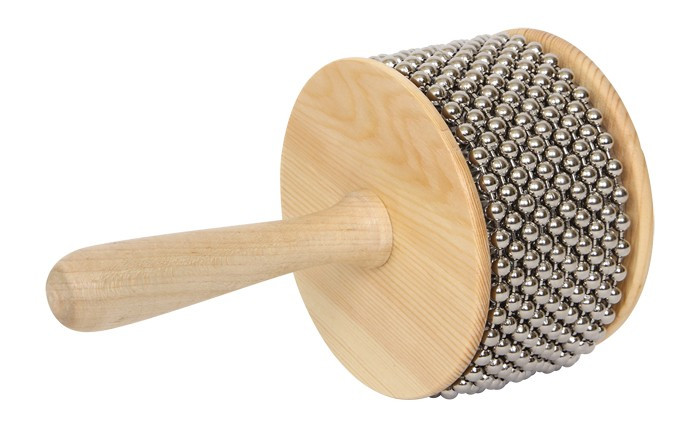
What about my choice of instruments I use with my clients? Does the client seem to want to touch textured things? I have many clients who are more engaged in our interventions when they play an instrument like the cabasa (picture below), which allows them to rub their fingers along the bumpy beads. Other ideas of instruments with great sensory feedback are guitar strings, chimes, hand drums, ocean drums, and resonator bells. The cabasa is one of my favorite instruments because it acts as a great massager, providing sensory input to arms, legs, backs, and soles of feet. For clients who are seeking tactile sensory stimulation, instruments like the cabasa can provide this in an appropriate way. Encourage the client to play the cabasa (or other instrument) and use it to provide sensory input independently. This way, the client is learning to self-regulate his/her out-of-sync sensory systems.


3317_cabasa_a.jpgOr for clients with an overresponsive tactile sense, choose instruments that don’t have a rough or uneven texture. Then encourage them to explore tactile sensations using the texture and vibrations of various instruments. This could help reduce defensiveness to certain tactile sensations.


Tactile_Sensory_Kit_6.jpg

As with all other sensory systems, there are so many things to consider when your child or client has an out-of-sync tactile system. Hopefully the ideas and considerations discussed here have sparked some ideas and increased your awareness of needs related to the tactile sense. Now, I challenge you to stop every now and then and become aware of the sensations on your skin and the things touching your body. Then imagine what it would be like if you could not seem to get enough of or control one of these sensations. How would you fix that?

-Chiara

What a journey the past 6 months of internship has been!  One year ago at this time I had no idea I would be moving to San Diego and building a life here.  I had no idea how intense life as an intern would be or how exciting the process of stepping out of the intern shoes and stepping into life as a new professional would be.  These past 6 months have taught me patience, confidence, and what it means to be invested in your dream.  There have been many lessons I’ve learned throughout internship, and I did my best to summarize my top learnings below.

1.      Your therapeutic relationship with the client is most important
While this may seem obvious, it was a valuable lesson I was reminded of through my experience as an intern.  So often it’s easy to jump into sessions with clients and get so absorbed in the goals and interventions that you forget that you haven’t yet earned the client’s trust.  The therapeutic relationship is really what makes music therapy effective – it is 100% essential to the clients success within therapy.  With time, I learned to breathe, be more present, be more aware of the client’s responses/what they are giving me and became comfortable adapting in the moment.  I also learned a great deal about building rapport with a wide range of personalities and different individuals.  Some clients connect with you through silliness/cutting loose a bit, some through structure, and others simply with time.  I learned to get to know my client’s and give the relationship time to grow before expecting them to trust/listen to me.

2.      Importance of professionalism and communication with parents/families
My experience in the field so far has taught me the vital importance of professionalism and communication.  I value clear and open communication and have come to understand how important this is in the workplace.  I have learned to communicate clearly with parents and families and (when possible) always keep them in the loop.  Within this lesson, I learned the importance of consistency, timeliness, and honesty/transparency as a measure of communicating respect and professionalism to the families with which you are working.

3.      Know your professional values
I have held several jobs in music therapy since beginning my degree.  Each has taught me more and more about what I value as a professional.  Sometimes the administrative end of music therapy can be equally as important as the therapy itself.  Sometimes small, logistical details determine whether you will be happy and well balanced, or overworked and burnt out.  I am learning to advocate for myself in these areas as well as cultivate a reputation for myself based on my personal values as a music therapist.

4.      Actively build/expand your skill set
There is always room for improvement, or as my mom told me often growing up “Learning is a lifestyle”.  I realized throughout internship how easy it is to get into a groove or routine where you’re comfortable, you and your clients know the drill and you rarely feel the need to mix it up.  However, mixing it up is where you’re challenged and where you grow!  I am inspired to expand my skills (particularly on guitar) as well as my repertoire of music.  Because we are in such a unique and fun line of work, it is a joy to get to be creative every day in the way you lead songs, present information, and address goals.

5.      Love where you are –> trust the process
The universe kept hitting me hard with this lesson, especially throughout internship, until it started to begin to scratch the surface of making it’s way into my head.  Many times we wish we were someplace we’re not – gotta learn to love and accept where we are.  Even if I don’t have years of experience (one day I will!) or am not the most knowledgable on certain subjects, I have to remind myself to breathe and accept where I am and be gracious with myself.  This proved to be particularly tricky when dealing with families or facilities who also wish you had more experience than you do.  All in time, all in time.  The difficulties will pass, the knowledge and expertise will come with experience, just trust that you are where you need to be.  I am where I need to be.

While reflecting on these lessons, I was drawn to record a piano piece that in a way represents the ebb and flow of internship for me.


Here’s to the future and all that lies ahead!

-Marissa

Behavior serves a function.  From infants to the elderly, humans behave the way they do for a reason.  When it comes to our clients, addressing the reason can sometimes be the first step towards making progress in their goal areas.

Recently in symposium, Shannon Wallace and Maryann Le of AEFCT came to present to our staff on “Function of Behavior Training”.  (Find out more about AEFCT here: http://aefct.com/)  Their presentation opened my eyes to several important factors to consider while working with clients.

A key concept in knowing how to address the behavior of a client is understanding the function of the behavior.  I learned that this is a phrase commonly used amongst behavior therapists that basically answers the question: why is the client doing what they are doing?  Is their behavior seeking to gain the attention of somebody or to meet a physical need (are they hungry.. thirsty.. need to use the restroom)?  What is their specific purpose for what they are doing?  Sometimes this can be a very tricky question to answer.

Consider the fact that many of the behaviors we as therapists view as “challenging” are behaviors the client probably views as functional, because engaging in them gets their needs met in one way or another.  Maybe screaming at the top of their lungs in the store gets them the toy they wanted (mom gives in to alleviate the situation).  Maybe engaging in disruptive behavior in the classroom gets them out of doing difficult work (they are removed from classroom for disciplinary purposes).

The 3 functions of behavior are:

  1. Positive reinforcement (behavior produces an outcomes that is desired by the child)
  2. Negative reinforcement (maladaptive behavior like escape or avoidance)
  3. Sensory Regulation (maladaptive behavior occurs in order to regulate the level of input from environment)

First determining the function of behavior helps us understand how to appropriately address it.  According to Shannon and Maryann, “When we know the antecedents and consequences of behavior, we can intervene in ways that provide an appropriate behavior that achieves the same function.”  This was one of the biggest lessons I learned through this presentation: the importance of providing an appropriate alternative to undesired behavior.  Since this time, I have been applying this principal in many of my sessions.  This includes things like redirecting a client who hits the table vigorously with his palms to playing a drum in order to receive that sensory feedback as well as redirecting a client who constantly asks what’s next by helping them give positive compliments to other group members.  Always be thinking how you can provide clients with a functional, appropriate alternative.

One final important aspect to consider is being on board with the parents with your strategies and approach towards behavior.  It is important that you are handling the behavior in a way that is congruent with how the parents are handling it at home.  Although this is not always possible, when it is, it can be extremely effective for the client.  Discuss strategies and approaches with your client’s family in order to determine what is best for them.

I’ll leave you with a short story of how these ideas have manifested themselves over the past month of my internship.  I have been working for 5 months with a non-verbal 8 year old client who, ever since I started with him, will manage to have a handful of my hair at some point in almost every session.  I have worked so hard on developing my “mom” voice, being stern, changing my affect, letting him know that is not okay, singing songs about having “gentle hands” and practicing what that looks like, redirecting him to a drum or other instrument or ignoring the behavior.  Although some of these tactics have seemed to work in the moment, we had a session 2 weeks ago where we were in the middle of an intervention at the piano together and I felt like we were connecting more than we ever have – he was sustaining eye contact, following directions, smiling at me – we were communicating so much nonverbally to each other through our playing.  I look down at him and he’s smiling so huge and then suddenly he reaches out and grabs two handfuls of my hair.  In this moment I realized that my assessment of the function of his behavior may have been off all along – maybe the reason he is engaging in this behavior is because he wants to communicate something to me and doesn’t have a way to do so.  I didn’t struggle against him or whip out my stern voice and say “not okay”, I instead maneuvered my head so that I could make eye contact with him and just looked at him with a neutral affect, locking eyes – simply letting him know I was there and present with him.  After a moment, he let go, no words were said and we continued with the intervention.  Since this time, I have been motivated to give him absolutely every opportunity to make a choice, communicate with his device, and request activities in an attempt to provide him with a means to communicate whatever it was he was trying to say by grabbing my hair.  Through my clients I am learning countless lessons about the function of behavior, communication and human connection.

-Marissa


This weekend marked a celebration – many friends gathered together to share in the joy of Reid Moriarty and his family over the completion of Reid’s newest album, “Shine”.

Shine album

Reid has been a client of Angela’s at The Music Therapy Center for many years and several of the songs from this album were ones they wrote together (with the help of many other talented musicians!)  It is a worship album that tells a beautiful story of the hope, joy, and fulfillment that Reid has found in God.  Over 14 musicians came together to be a part of this project – from writing the songs, to recording in the studio, to mixing the finalized product – and had the privilege of celebrating the end result at yesterdays “Listening Party”  hosted by the Moriarty’s.

Reid at listening party

Listening Party fun Shine

I have had the pleasure of working with Reid during my internship and am constantly amazed at his creativity, genuine care for others, and love of life.  He will make your day with just a few words, guaranteed!

If you’re interested in buying Reid’s album as well as learning about any of his upcoming gig’s and other projects, please visit: http://www.reidmoriarty.com/

Reid, you are truly an inspiration and I’m so grateful that I came to know you during my time at MTCCA.

Keep on shining!

Reid Allie and Marissa.jpg

-Marissa

Jam session.jpg

This past week, Banding Together’s Spring season of Jam Sessions came to a bittersweet end.  Throughout the past 5 months of being an intern, Jam Sessions became one of my weekly highlights and I will treasure some very special moments and memories from my first season being a mentor with Banding Together.

This Jam season I learned to watch, listen, and learn (in that order!).  I truly learned so much from observing the mentors/volunteers interact with and encourage participants as well as from participants being genuine friends to one another.  In my experience as an intern, so often I am jumping into things – taking leadership and problem solving – that this experience proved to be a very important opportunity for me to sit back and learn from watching others.  The patience, wisdom, and gentle, humble leadership I observed in other mentors taught me to be more aware of myself and to consistently encourage clients to be the absolute best they can be.

Another highlight from this season, was having the privilege of seeing participants experience such excitement and sheer joy when Jason Mraz performed as a Guest Musician.  This was such a special night of sharing in music with someone who has touched the world with his message and gift.  Thank you, Jason!

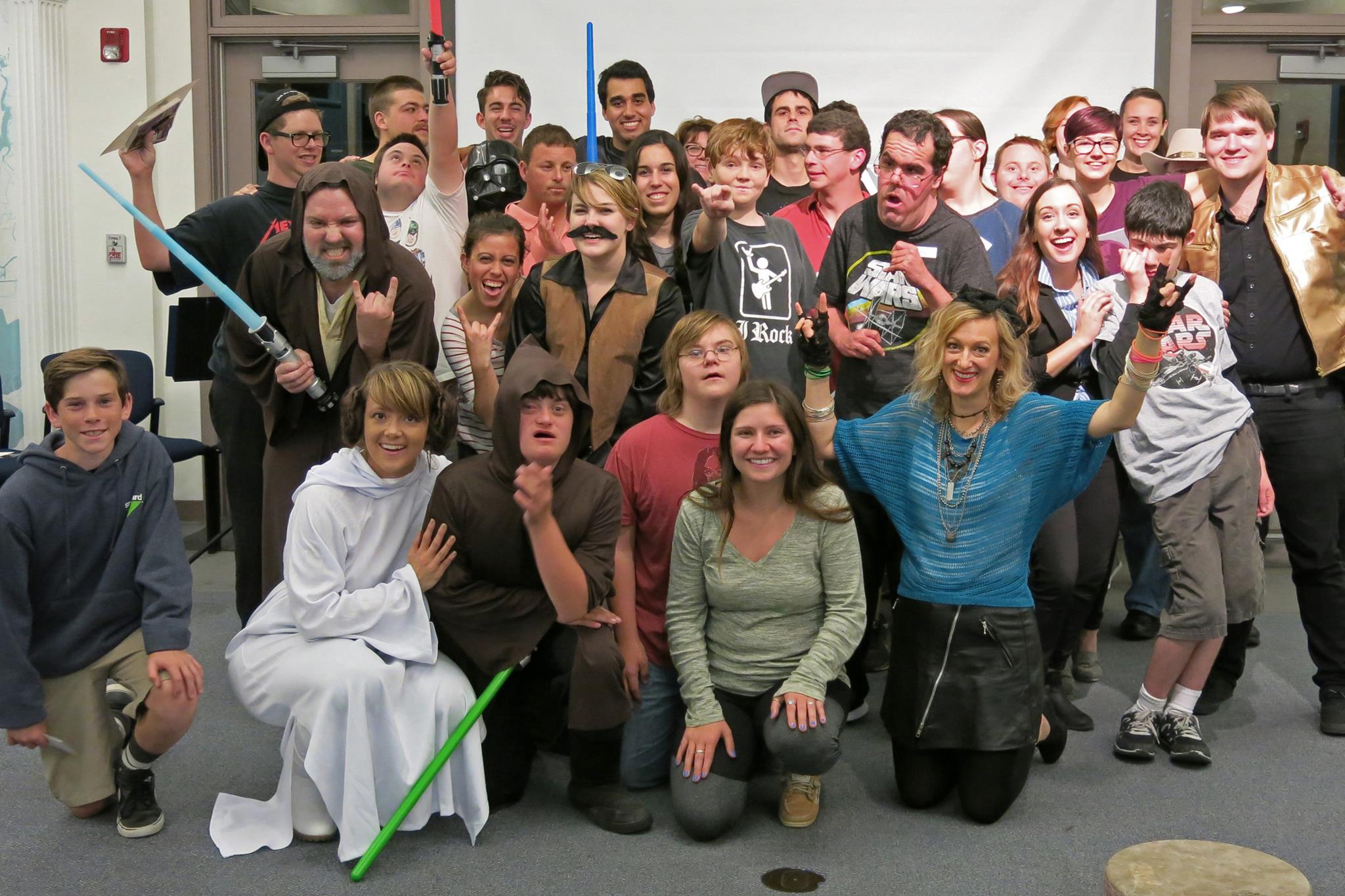
Lastly, Jam Sessions proved to be a complete blast!  The dance moves, the drum circle grooves, the action leader skills, personalities shining through with solos or at the mic, the relationships deepened and laughs shared… for me it was a true expression of the power and joy of making music with others.

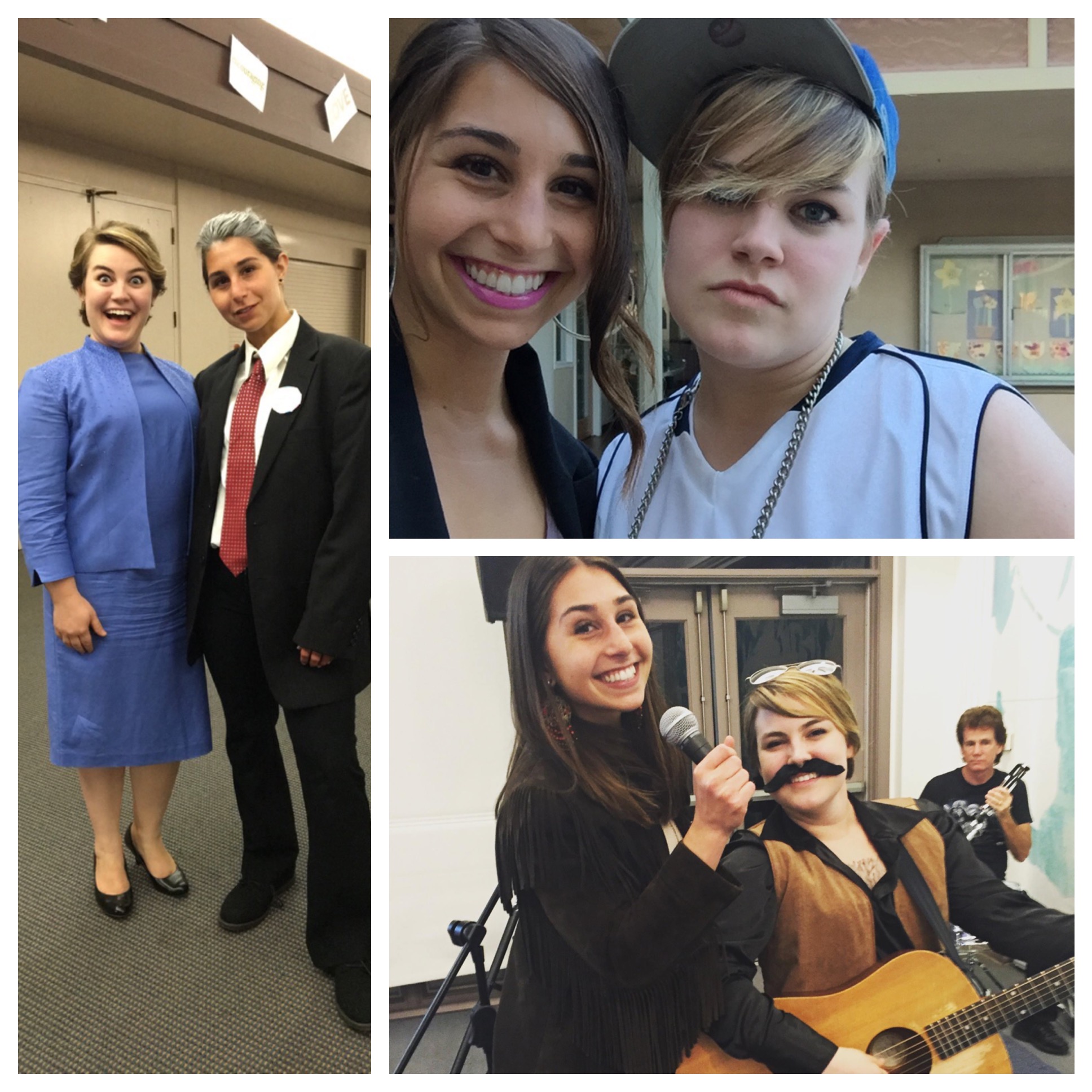
On a final side note, Chiara and I thoroughly enjoyed ourselves while taking the “Dress up as your favorite rock star!” prompt to heart.  Enjoy these pics of us as Jelena (Justin and Selena), Sonny and Cher, and Billary (Bill and Hillary).  (Oh, the many perks of being an intern!)

IMG_7002.JPG

That’s a wrap for our Spring session – here’s to another great one this fall!

Cheers!

-Marissa

First of all, let me give a special thanks to Veronica May, MT-BC, NMT for coming to The Music Therapy Center to, in her words, “brickity break down” some Neurologic Music Therapy physical and sensorimotor techniques for us, and give us specific tools to use with our clients. The following information is based on her helpful instructions.

Music motivates movement! That is why there is a whole category of neurologic music therapy techniques that address physical and sensorimotor goals. One technique is Patterned Sensory Enhancement (PSE). PSE uses the elements of music – harmony, dynamics, rhythm, melody, tempo, and duration – to mirror a specific movement. It is used in motor rehabilitation, maintenance, or modulation.

In PSE, music is not only motivating movement, but it’s also illustrating the movements. When a music therapist chooses what type of music to play and how to play it in order to facilitate a specific movement, he/she must take all the elements of music into consideration: 1. Timing elements: meter, tempo, pattern, form; 2. melodic elements that indicate spatial aspects of movement: pitch, dynamics, sound duration, harmony. In addition to musical elements, the music therapist must also be aware of the elements of the movement his/her client is being prompted to do. What are the steps involved in making the specific movement? Where is the force of the movement coming from?


Enough with the technicalities! How about some examples for how MUSIC can ILLUSTRATE and FACILITATE MOVEMENT!

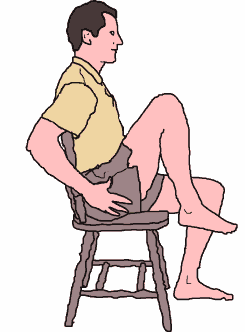
Example: Knee lifts from a seated positionSeatedKnRse2

First, where is the force of the movement? The LIFT, because this is going against gravity. Therefore, the “force” – or most emphasized – part of the music will be on the lifting motion.


Second, let’s think about the music.

  1. Meter: Knee lifting is like marching, so we would likely want a march meter (i.e. 2/4 or 4/4). Find a song, or plan your improvisation in that meter.
  2. Tempo: At what speed do you want your client making each movement? Choose the tempo that is most appropriate for your client’s age and motor challenge. Remember, slower tempos are sometimes harder for clients to maintain because there is less auditory info happening between each beat.
  3. Pitch: You want your client to make an upward movement, so instinctively, you play higher pitches to cue the lifting movement (e.g. a high C chord), and lower pitches to cue the lowering movement (e.g. low C).
  4. Dynamics: In this case, dynamics will help you emphasize the pitches that cue the lifting movement. Play the higher pitches louder and the lower pitches softer. E.g. Loud high C chord, soft low C.
  5. Duration: You can cue how long you want your client maintaining his/her knee in that lifted position by sustaining the high pitches (e.g. sustained high C chord), or making those same pitches very shor
  6. Harmony: Harmony doesn’t play a crucial role in this knee-lift example. But it can tie in to the emphasis piece. Emphasize the lifting motion by making the high pitch a chord (e.g. high C chord), and the low pitch just a single note. I’ll give another example. A clenching movement may be associated with a dissonant chord, while a relaxed/releasing movement may be associated with a consonant chord.

– Chiara (the new intern!)

If you are a music therapist, you know the feeling – you’re on an airplane or in an elevator when someone asks you what you do for a living.  The 30 seconds that follow have the potential to forever shape that individual’s understanding and view of the vast world of music therapy.  No pressure!

The vital importance of being an effective communicator and speaker cannot be over stated.  Whether your field is music therapy, marketing, or dog sitting, you have the power to help others understand the value and efficacy of your work.  So much about an individual brand or company is communicated in the initial, first-impression conversation and it’s crucial that you are prepared.

Recently in symposium, we discussed the (slightly overwhelming) topic of public speaking/presenting/communicating effectively.  Here are some helpful take aways if you’re looking to boost your ability to persuade, engage, and win-over others.

  1. Know your audience! Before you are able to effectively “sell” anything (whether services, an idea, a suggestion) to anyone, you first have to understand why it matters to them.  If you were speaking to a woman who has an 85-year-old mother with Dementia, do you think you would describe music therapy differently than if it were a man with a 4-year-old son with Autism?   Knowing your audience is so important to understanding how to effectively communicate with a variety of people.  When beginning a conversation, practice asking quick questions to get to know the person, where they’re coming from, and what they’re looking for in music therapy (or any other topic/field you may be discussing).
  1. Know your material. If you are educated, knowledgeable and well-rounded in your area of expertise, you are already set up for success to be an amazing communicator!  Remember, you are the expert.  Own what you say.  Use confident language like “we do” and “we are”, and be prepared to answer a variety of questions that might arise.  If you truly know your material, whether it is a 60-minute presentation, or a quick exchange in line at the grocery story – it will make all the difference in your confidence and will impact the other person’s quickly-forming opinion of you and of the field.
  1. Focus on the message, not on yourself. This is key!  As soon as we stop worrying about what the audience/other person is thinking of us, or how our voice sounds, or what our hair looks like, etc. etc., our message immediately becomes more impactful!  Focus on exactly what you want to communicate and on the power of your message.

For more helpful tips, visit Toastmasters.org.  They have a variety of free resources, from articles and videos to podcasts and conventions.  Some of the above tips were drawn from the following video:

And remember, haaaaave fun with it!

haaaaave fun with it

-Marissa