

logo

Drop us a Line

info@themusictherapycenter.com

April 2021

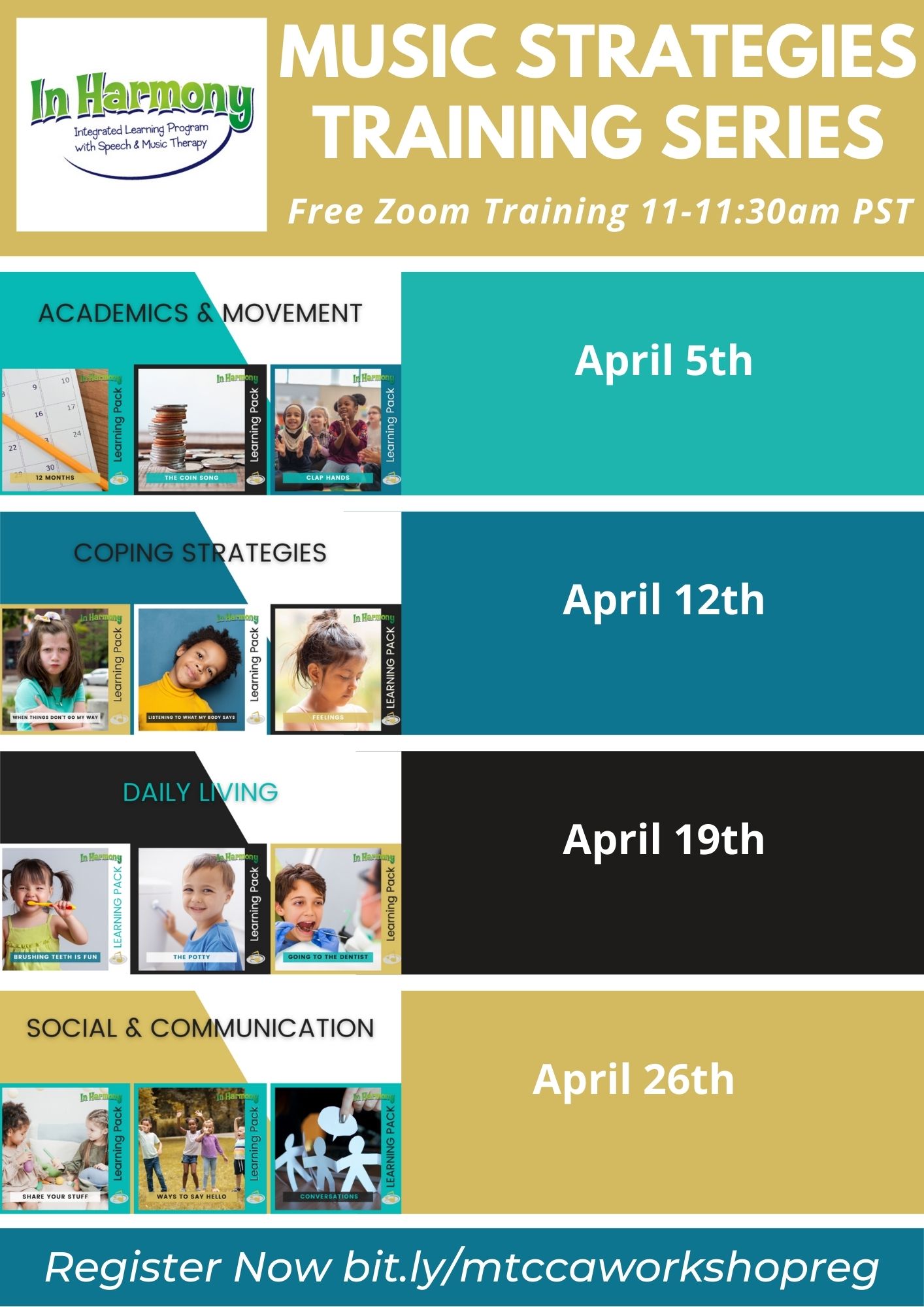
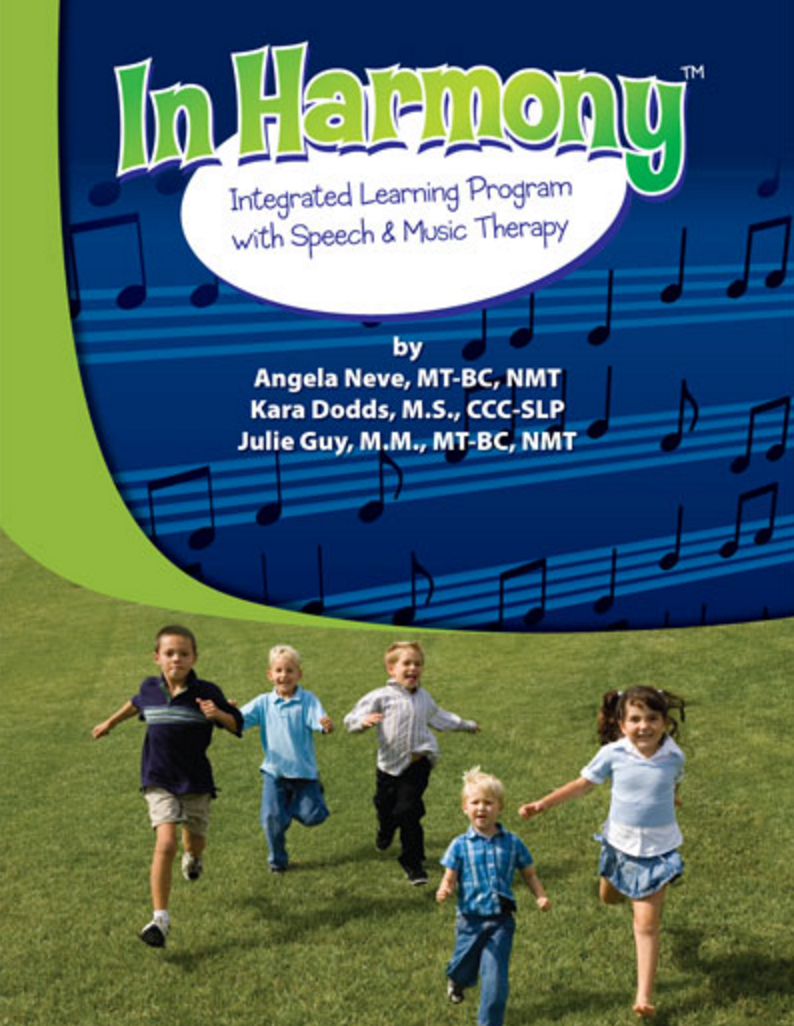
I recently had the opportunity of attending a training webinar on using music for coping strategies. Julie Guy and Angela Neve used a song from their integrated learning program, In Harmony. In Harmony combines specialties of music and speech therapy in order to teach kids essential life skills (social, academic, daily living, etc.). One of the primary takeaways from their webinar was their structured protocol for each lesson:
  1. Interact and learn – Learn the song with visuals or hand-motions to help.
  2. Pause for understanding – Review the song.  Try using the karaoke track for practicing the lyrics.
  3. Fade the music – Pull back the music to transition from singing to speech.
  4. Generalize – Generalize the lesson and apply it to practical situations in everyday life.

I think these steps are a helpful framework for how to use these songs at home. It is important to make music lessons interactive. I am a kinesthetic learner, so the best way for me to learn is by interacting with a concept physically. Another helpful way to retain new information is by applying it to your own life. For instance, when you are using music to learn new coping strategies, consider a moment when you could have used a coping strategy.  Use it as an example in the song! When the situation comes up again, sing the song. Even simply reciting the lyrics can be grounding.

In Harmony is an amazing resource including 60 page full-color digital program manual, 24 audio files and 120 color-coded digital photo flashcards. Printable chord charts and instrumental tracks allow the program to be adapted and customized to individualized needs. The In Harmony Integrated Learning program is available for purchase on MTCCA’s website. Additionally, individualized learning packs are available teaching skills such as brushing teeth, sharing our things, and starting conversations.

Join us for the rest of our series! Our next topic is “Daily Living” on April 19th. Anyone interested in learning about using music to teach children essential life skills is welcome to attend. Register here for free! Or attend a 2-hour In Harmony Music Strategies workshop sponsored by our friends at Autism Tree Project Foundation on April 29th for a $10 donation to their organization.

ATPF In Harmony Workshop Flyer

Learn more about teaching social skills through song here!

-Emma
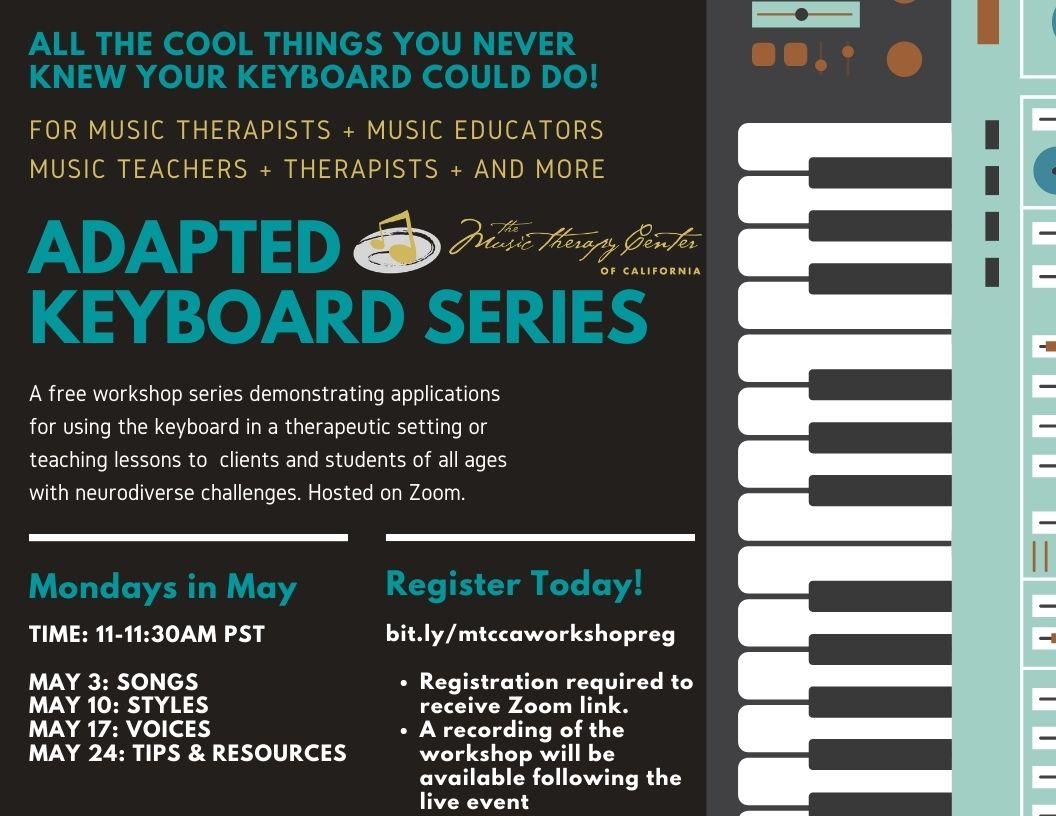
All the cool things you never knew your keyboard could do!

Join MTCCA for a free training series demonstrating applications for using the  keyboard in a therapeutic setting or teaching lessons to clients and students of all ages with neurodiverse challenges. Hosted on Zoom.

Mondays in May at 11am PST.

Register here: http://bit.ly/mtccaworkshopreg

Woo we’ve made it to the end of internship! It’s crazy to look back at where I started and acknowledge the progress I’ve made at the finish line. In so many different facets of life, I’ve grown throughout this internship and I can’t believe I’m at the end of this journey. I’ve had such an amazing experience being an intern at MTCCA, and I wanted to share my top 10 learnings with you.

  1. It’s okay not to have all the answers. This has been an interesting lesson to learn, as I love to know what is coming next for security’s sake. Not only this, I also try to do things to the best of my abilities and want to avoid feeling like I’m doing a disservice to myself and others around me if I don’t know what is happening next. While this can be frustrating at times, at the end of the day I’ve learned that it’s okay not to know everything that is going to happen. In the world of music therapy, you may not know how a client is going to respond to an intervention, you may have plans change throughout the day and you may not know how to do something you feel like you should know how to do. Don’t beat yourself up, and instead realize that there are so many learning opportunities and it’s okay not to have all the answers.
  2. Comparison is the thief of joy (seriously). I am naturally someone who likes to achieve and do things to the best of my abilities, but I’ve realized this can come with lofty expectations. I had moments at the beginning of internship where I thought I was never going to be able to do what my supervisor and other therapists on the team were doing and this led to some negative self talk and doubts. As someone fresh in the field of music therapy, holding myself to the expectations that I should be doing everything as well as the other therapists on the team was simply not reasonable for myself, especially in the first couple of months of internship. Everyone has their own strengths and I’ve learned that these strengths play into one’s role as a music therapist in so many different ways.
  3. Use your primary instrument. I had never really used my clarinet in sessions during college practicums, but I have learned so many cool ways to use my clarinet in sessions throughout my internship (I wrote a separate blog post about this, also). It’s been wonderful using my instrument during various opportunities in sessions, and I love seeing the way clients respond to the clarinet. It’s also rewarding to know that the years of studying on my instrument can continue to pay off outside of school!
  4. The Yamaha EZ220 is life changing. Using the EZ220 keyboard has made so many sessions more engaging and motivating for clients. There are so many cool features on the keyboard that are great for transitions, Name That Tune, attention skills, fine motor skills. As someone who did not have many years of piano experience, the EZ220 keyboard has been so helpful in providing immediate auditory feedback that can address client goals by just clicking a few buttons.
  5. Find a system that works for you. This applies to so many facets of internship. Whether it be time management, data collection, session planning, or even leading sessions, find what works best for you. This is something that took me a couple of months to develop just because of the newness of everything, but once I was able to figure out how I best work, I was able to increase efficiency and make less stress for myself in the long run.
  6. Learn how to be the best version of yourself. This may sound kind of cliche, but it’s true, especially on days where you don’t feel at your best. From experience, there were a few days during internship where I did not feel well (the second COVID vaccine was a doozy for me!) but I still had responsibilities to my co-therapists and clients to be as close to my best as possible. When we feel 100%, of course it is much easier to get things done and feel energized to do tasks than if we are not. It certainly isn’t easy, but it’s during these times when we don’t feel our best that we need to put our best foot forward for those we serve.
  7. Prioritize, please. Throughout college, I was always able to prioritize things well and figure out what I needed to work on. During internship though, there are so many different responsibilities and tasks that it is important to readdress how you prioritize and what things should be at the top of the “to-do” list. Taking a weekly inventory of what tasks I needed to complete each week was helpful for me. Ultimately, it’s great to narrow down as much as possible to one or two individual tasks that are the highest priority, even though sometimes it can feel like everything needs to be prioritized. This is a significant learning for me, as I’ve learned to take each day as it comes and figure out what my daily and weekly priorities are.
  8. Give yourself grace. Internship is a huge learning experience. Similar to point number 1, you aren’t expected to know everything and people are there along the way to help you! I have appreciated all of the support, advice, constructive criticism provided by various people throughout my internship, as these have alleviated a lot of my questions and/or concerns and have helped remind me that the things I’m learning during internship are not always easy. It’s natural to make mistakes or to do things incorrectly during internship and I’ve learned that these experiences don’t define me, but instead make me more equipped for future experiences and are building my strengths and skills.
  9. Take time for you. Self care is such an important aspect of being a music therapist. There are instances where you may feel like you’re expending all of your physical, mental and emotional energy in the work that you do so it is important to find avenues outside of the office that allow you to refresh. This looks different for everyone, but I’ve found that going to the beach, talking with friends and family, going on walks, getting extra sleep, and drinking water are a few things that have worked for me in regards to self care during internship. Being in such a beautiful city as San Diego, I’ve definitely taken advantage of some beautiful scenery to provide some self care.
  10. You are stronger than you think. This is so true! I knew I’d learn about music therapy during the internship, but I had no idea I’d learn so much about myself. For the internship, I took my Strength’s Finder test and identified that 4/5 of my strengths are all relationship based strengths. These strengths have really played into my approach as a therapist and I’ve enjoyed getting to watch all five strengths become (ironically) stronger! Also, there are so many things coming your way during internship and it can feel like you aren’t able to handle it all, but trust me, you totally can! There are little victories along the way that lead up to the huge victory of completing internship and you are certainly capable of doing it all.

I have enjoyed sharing my learnings with you along the way of internship. It is crazy that this chapter has come to a close, but I’m so incredibly grateful for all I’ve learned along the way. Thank you for following this journey with me!

Katherine

Hello and welcome back to another blog post!

Through my internship, I have been given various presentation opportunities. I have experienced what it’s like to prepare for and present to an audience (virtually, of course) both at the national and regional music therapy conferences. In fact, one of the most recent presentation opportunities I’ve had was led by my internship director, Julie, where we talked about cool functions available on any keyboard including the Yamaha EZ-220 keyboard!

I never had experience using the EZ-220 keyboard prior to internship, so it was a learning curve figuring out what the different buttons on the keyboard do. Let me tell you though, it is a game changer when you learn how to use the cool functions! At the presentation, we discussed ways to use the song, style, and voice settings on the keyboard in therapy sessions. Certain settings, such as the follow the lights setting, are great for addressing goals such as sustained/selective attention and/or isolating individual fingers using a familiar song. The style setting is also great for picking a motivating background beat and providing steady and consistent tempos for rhythmic entrainment. The voice setting is awesome for motivating clients and making the keyboard sound like another instrument (e.g. a trumpet, electric guitar).

At the presentation, we also discussed the different ways of helping clients become more successful at using the keyboard by giving them opportunities to make choices when appropriate. For example, MTCCA has an adaptive keyboard kit of picture visuals that correspond with different songs, voices and styles. This can allow clients to make decisions for what to play on the keyboard based on the visuals. Along with this, we talked about other aspects of the kit that can be beneficial for clients, such as the color coded system with stickers and tabs to provide more visual support when figuring out the functions of the keyboard.

Benefits of the adaptive keyboard kit

It was a great opportunity overall to be able to present virtually and have experience interacting with audience members over a virtual platform. While it wasn’t in person, I still learned valuable information about ways to have an engaging presentation. For example, using visuals and pictures is an awesome way to engage people rather than having them read off of a screen with lengthy information. Another way of making a presentation engaging is to provide personal accounts or stories. I did this by providing a brief introduction and recounting specific client stories of when they’ve used the EZ-220 keyboard in sessions. This helped not only show a real life example of how to use the keyboard, but it also broke down the barrier between me as a co-presenter and the audience. The last thing I learned was to not take myself too seriously! Presentations or public speaking in general are skills that always made me anxious, but it helps to remind myself that I am human and that it’s okay to let my personality shine during these opportunities (no matter how goofy I actually am!).

If you want more information about purchasing the adaptive keyboard kit, click here. To purchase the EZ-220, click here.

There is also an amazing opportunity to learn more in depth about various functions of adaptive keyboards in MTCCA’s upcoming “Adapted Keyboard Series!” This is a free workshop series hosted on Zoom each Monday in May of 2021 and describes different ways to utilize the keyboard in both therapeutic and adaptive lesson settings. For more information and to register for the series, click this link!

Katherine

Who loves free trainings?

Need some new tips and music strategies for your toolkit?

Join MTCCA founders Angela Neve Meier, and Julie Guy for our new webinar series designed to give you the tools you need to be successful whether you are at home, the clinic or in the classroom.

To register for the LIVE version on Mondays at 11am in April (or to get the link for the recorded version if you can’t join live), register here: http://bit.ly/mtccaworkshopreg

Did you miss this training? We’ve got you covered!

You can download this series FOR FREE over in our Shop!