

logo

Drop us a Line

info@themusictherapycenter.com

Uncategorized

Before starting my internship, I was required to read a book called Who Moved My Cheese – a story about dealing with changes in life. We recently revisited the book and discussed some of the metaphors and lessons in it. This seems fitting, as my internship is almost finished now, and it’s time to start facing the next big life change: entering the professional world.

The book uses cheese as a metaphor the status quo/what makes us feel comfortable/our purpose/our current relationships/etc. Eventually, the cheese is consumed, as cheese is meant to be. We’re then faced with a choice: do we go out looking for new cheese (i.e. do we change with the changes) or do we stay put, mistakenly expecting our old cheese to reappear? Then, if we choose to change with the changes and go out looking for new cheese, what happens when we don’t find it when and where we expect?

I remember when I was first reading this book. I was anticipating starting my internship with the Music Therapy Center, and very grateful that the life change that I had been anticipating for the previous 4 years was finally happening. But the process of getting an internship had not gone as planned at all. In the end, it was clearly for the best. But in the 8 months before being accepted into the internship at MTTCA, as I repeatedly couldn’t find my new cheese, I became discouraged.

I applied to 5 internships initially, and thought for sure someone would offer me cheese! Four rejected me and one discontinued their internship before my application even got to them. My neatly laid out plan and timeline for where and when I would find my much-anticipated new cheese was useless. I had to start the search all over again.

I’m sure glad I didn’t stop looking for my cheese! The next round of 4 applications brought me two cheese (read “internship”) offers, in an area of music therapy I had not originally considered. And as I sit here typing this blog post, I’m filled with overwhelming gratitude for how perfect this cheese has been for me. It has helped me discover and shape my life calling and dream. Not only that, but it has also built in me invaluable skills, given me beautiful friendships, and equipped me to pursue my own potential just as we strive to help our clients pursue theirs.

The moral of this cheese story is that even when you’re anticipating the end of your cheese, there may not be new cheese where you expect it. You have to keep searching, maybe trying new routes and new angles. Maybe try looking for a different type of cheese – maybe you need to look for gouda instead of brie. This moral is a good one to reflect upon as I start looking for my new cheese (read “job”). It may not be where I expect it to be, and it may not be the type of cheese I think it should be. But, just like this internship, it will be exactly what I need.

  • Chiara

Recently we discussed adapted music lessons at one of our symposiums. In preparing for this symposium, I read two articles written by music teachers working with students on the autism spectrum. After reading these articles, I started re-examining my approach when teaching adaptive music lessons. Am I really striving to find out how the student learns best? Am I really letting their strengths shine in our lessons? Am I pushing them to achieve something that isn’t actually feasible at the moment? Am I really offering them an opportunity to enjoy the music, or am I just pushing my agenda?

It was scary asking myself those questions. Some of the answers revealed that I was not actually living out my belief that these students are capable and unique, and that music learning does not have to be this rigid, structured, experience.

So I’ve begun making some changes in my teaching. For example, last week during a lesson, my student was perseverating on one particular part of a song. When I tried to interrupt his playing to make suggestions, he did not seem to hear me. Eventually, he stopped playing. At that point, instead of giving him the suggestions I had planned on giving, I asked him, “What are you thinking about right now? Tell me what’s going on in your head.” Why had it not occurred to me before to get his perspective first??? After all, this lesson is for him and his benefit. Asking him that question gave me insight into his approach to the piece we were working on. It lead to a different method of teaching the song.

The student in this example is very high functioning on the spectrum and has the appropriate language skills for expressing his thoughts and feelings. Of course, it becomes more complicated to gain insight into a student’s thought process when they don’t have the language skills. But, I’ll deal with that when the time comes. For now, I’m grateful for this change in perspective, for my students’ sakes!

  • Chiara

We live in a very busy, fast paced society.  It is very easy to become preoccupied with our daily responsibilities, and the stresses that accompany those responsibilities.  This is why it is important to take a step back, and take a look at what you are doing for your self-care in order to maintain balance.   Developing a self-care plan is a great way to increase your focus on wellness.  The Self-Care Community for Music Therapists Facebook page is a great resource for developing your self-care plan.

Among many valuable tools this wonderful page offers, the self-care plan is a great way to start by making a list of what you can do to maintain balance.  You begin making your self-care plan by reviewing the different categories such as: workplace or professional self-care, physical self-care, psychological self-care, emotional self-care, spiritual self-care, and relationship self-care.  There are various bullet points within each category that suggest what you can do.  For example, a couple suggestions under the workplace or professional self-care category are: “Engage in regular supervision or consulting with a more experienced colleague”, and “Set up a peer-support group.”  Other suggestions under the psychological self-care category are, “Engage with a non-work hobby”, and “Make time to engage with positive friends and family.”

It is suggested that you pick one or two suggestions from each of these categories to assemble your self-care plan.  There is a power with creating lists, as you are more likely to take action when putting your ideas into writing.  Once you have created your list, it is recommended that you put your self-care plan in a place where you can see it on a regular basis.  Being able to see your plan daily will also be helpful with being able to commit to your strategy.

When a month has passed, you can then assess how you are doing with developing these new habits.  Creating a self-care plan provides a great start on being able to take action towards promoting your personal wellness.  By having a self-care plan, one is likely to be more effective in the workplace, and less likely to experience burn-out.  I highly recommend checking out The Self-Care Community for Music Therapists Facebook page to start developing your self-care plan at: https://www.facebook.com/groups/629527543823408/  Be well everyone!

-Brandon

You’ll hear music therapists tell you time and time again, “Music therapy is an EVIDENCE BASED field!” What we do it backed by empirical research, and we’re very proud of this fact. However, the fact that the field is supported by research showing the efficacy of using music as a therapeutic tool for accomplishing non-musical goals does not make music therapy a lone-ranger in the world of therapies. There’s a key phrase I used in the previous sentence: “non-musical goals”. This means that the goals we are addressing in music therapy are similar to the goals our client’s are working on in their other therapies (speech, occupational, physical, behavioral, and cognitive rehabilitation therapies, etc.). So, in the Neurologic Music Therapy branch of our field, in particular, when setting up our interventions for addressing a non-musical goal, we like to use a model called the Transformational Design Model (TDM).

Transformational Design Model! It sounds like a superpower. And in a way, it is. It’s the superpower model that transforms non-musical interventions into musical interventions. Because music therapy has the same functional structure as other therapies, music therapists use this model to see where the overlap is with other fields, and then how the addition of music to a treatment intervention can benefit the client. But wait, there’s more! This superpower model transforms the functional music intervention into functional, non-musical real-world application. In short, we’re not going to let you walk around singing the steps to making conversation. We’re going to help you generalize the information you learned through music, so that when you apply it to everyday life, you’re doing it in a socially acceptable and sustainable (functional) way.

photodune-4789539-superhero-kid-small.jpg

I know you’re dying to find out how one mere mortal can acquire such a superpower. Well, lucky for you, we can let you in on the bare bones of the model. I take myself through these steps every time I develop an intervention for a client, and it helps ensure the quality and efficacy of my interventions. Ok, are you ready to be transformed?

  1. Asses the client’s strengths and needs
  2. Develop the goals and objectives
  3. Research how a non-music therapist addresses this same goal and design a functional non-musical intervention
  4. Translate step 3 into a functional musical intervention
  5. Transfer step 4 to functional, non-musical real-life application

This model is a superpower not just in the fact that it transforms a non-musical skills into a musical experience and then back into a non-musical skill, but also in the fact that it allows multiple therapeutic fields to see their overlap. The more therapists from varying fields can work together, the more well-rounded the treatment plan becomes, and the more the client will benefit. Go transform something!

-Chiara

Your body is always touching SOMETHING. What an interesting thought that most people don’t spend too much time dwelling on. That’s because the brain with a well-regulated tactile sense only briefly makes note of the thing that the body is touching, and then ignores it in favor of more important thoughts and sensations it needs to process. But for a person whose tactile sense is out-of-sync, the textures of certain fabrics or presence of a tag on their clothing may be a source of extreme discomfort and the cause for much distress. Or they may lunge at you for a bear hug because they crave the feeling of deep pressure squeezes. Or they may not seem to notice that their hand is on a hot pan until they have a third degree burn. These are only a few examples, of course. The main point is, our tactile sense helps us determine what we are touching and if the things touching us at every moment of every day are harmful or helpful. An out-of-sync tactile sense may make a person overresponsive to stimuli, underresponsive to stimuli, sensory seeking, or a combination of these, or may make it difficult to determine what the tactile stimulus is or where it is touching.

How does this affect my work as a music therapist? I can start by considering the environment of my treatment space. What is the client’s reaction to the texture of the chair he/she is sitting in? For some of my clients with tactile sensory needs, sitting on a fuzzy pillow that buzzes provides the tactile sensations they need to be aware and in control of their bodies. For other clients, sitting on a rubbery and bumpy cushion serves this same purpose. What is the client’s reaction to the carpet? I have clients who prefer to have their shoes off during sessions. One such client likes having the afore mentioned rubbery cushion under his feet. From which direction is the air conditioning blowing and is it blowing directly on my client? I’ve barely scratched the surface of tactile elements to consider in the environment of the treatment room, but you get the picture.

child-playing-with-rice.jpg

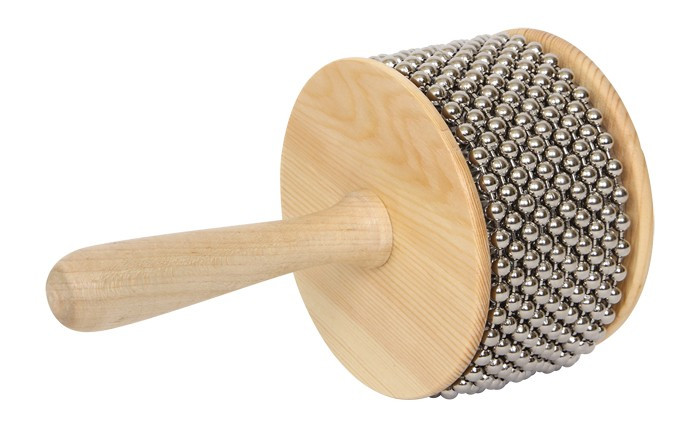
What about my choice of instruments I use with my clients? Does the client seem to want to touch textured things? I have many clients who are more engaged in our interventions when they play an instrument like the cabasa (picture below), which allows them to rub their fingers along the bumpy beads. Other ideas of instruments with great sensory feedback are guitar strings, chimes, hand drums, ocean drums, and resonator bells. The cabasa is one of my favorite instruments because it acts as a great massager, providing sensory input to arms, legs, backs, and soles of feet. For clients who are seeking tactile sensory stimulation, instruments like the cabasa can provide this in an appropriate way. Encourage the client to play the cabasa (or other instrument) and use it to provide sensory input independently. This way, the client is learning to self-regulate his/her out-of-sync sensory systems.


3317_cabasa_a.jpgOr for clients with an overresponsive tactile sense, choose instruments that don’t have a rough or uneven texture. Then encourage them to explore tactile sensations using the texture and vibrations of various instruments. This could help reduce defensiveness to certain tactile sensations.


Tactile_Sensory_Kit_6.jpg

As with all other sensory systems, there are so many things to consider when your child or client has an out-of-sync tactile system. Hopefully the ideas and considerations discussed here have sparked some ideas and increased your awareness of needs related to the tactile sense. Now, I challenge you to stop every now and then and become aware of the sensations on your skin and the things touching your body. Then imagine what it would be like if you could not seem to get enough of or control one of these sensations. How would you fix that?

-Chiara

What a journey the past 6 months of internship has been!  One year ago at this time I had no idea I would be moving to San Diego and building a life here.  I had no idea how intense life as an intern would be or how exciting the process of stepping out of the intern shoes and stepping into life as a new professional would be.  These past 6 months have taught me patience, confidence, and what it means to be invested in your dream.  There have been many lessons I’ve learned throughout internship, and I did my best to summarize my top learnings below.

1.      Your therapeutic relationship with the client is most important
While this may seem obvious, it was a valuable lesson I was reminded of through my experience as an intern.  So often it’s easy to jump into sessions with clients and get so absorbed in the goals and interventions that you forget that you haven’t yet earned the client’s trust.  The therapeutic relationship is really what makes music therapy effective – it is 100% essential to the clients success within therapy.  With time, I learned to breathe, be more present, be more aware of the client’s responses/what they are giving me and became comfortable adapting in the moment.  I also learned a great deal about building rapport with a wide range of personalities and different individuals.  Some clients connect with you through silliness/cutting loose a bit, some through structure, and others simply with time.  I learned to get to know my client’s and give the relationship time to grow before expecting them to trust/listen to me.

2.      Importance of professionalism and communication with parents/families
My experience in the field so far has taught me the vital importance of professionalism and communication.  I value clear and open communication and have come to understand how important this is in the workplace.  I have learned to communicate clearly with parents and families and (when possible) always keep them in the loop.  Within this lesson, I learned the importance of consistency, timeliness, and honesty/transparency as a measure of communicating respect and professionalism to the families with which you are working.

3.      Know your professional values
I have held several jobs in music therapy since beginning my degree.  Each has taught me more and more about what I value as a professional.  Sometimes the administrative end of music therapy can be equally as important as the therapy itself.  Sometimes small, logistical details determine whether you will be happy and well balanced, or overworked and burnt out.  I am learning to advocate for myself in these areas as well as cultivate a reputation for myself based on my personal values as a music therapist.

4.      Actively build/expand your skill set
There is always room for improvement, or as my mom told me often growing up “Learning is a lifestyle”.  I realized throughout internship how easy it is to get into a groove or routine where you’re comfortable, you and your clients know the drill and you rarely feel the need to mix it up.  However, mixing it up is where you’re challenged and where you grow!  I am inspired to expand my skills (particularly on guitar) as well as my repertoire of music.  Because we are in such a unique and fun line of work, it is a joy to get to be creative every day in the way you lead songs, present information, and address goals.

5.      Love where you are –> trust the process
The universe kept hitting me hard with this lesson, especially throughout internship, until it started to begin to scratch the surface of making it’s way into my head.  Many times we wish we were someplace we’re not – gotta learn to love and accept where we are.  Even if I don’t have years of experience (one day I will!) or am not the most knowledgable on certain subjects, I have to remind myself to breathe and accept where I am and be gracious with myself.  This proved to be particularly tricky when dealing with families or facilities who also wish you had more experience than you do.  All in time, all in time.  The difficulties will pass, the knowledge and expertise will come with experience, just trust that you are where you need to be.  I am where I need to be.

While reflecting on these lessons, I was drawn to record a piano piece that in a way represents the ebb and flow of internship for me.


Here’s to the future and all that lies ahead!

-Marissa

What is Music Sensory Orientation Training (MSOT)?  MSOT is the use of music, presented live or recorded, to stimulate arousal and recovery of wake states and facilitate meaningful responsiveness and orientation to time, place, and person. In more advanced recovery of developmental stages, training would involve active engagement in simple musical exercises to increase vigilance and train basic attention maintenance with emphasis on quantity rather than quality of response (Ogata 1995). Essentially we are using music and sensory based methods to access sensory channels, modify state, and provide sensory stimulation for growth.

Who can benefit? Individual with sensory processing disorder, aging older adults with dementia and Alzheimer’s, and individuals with developmental disabilities.

What is the goal? increase vigilance and train basic attention maintenance with emphasis on quality of response.

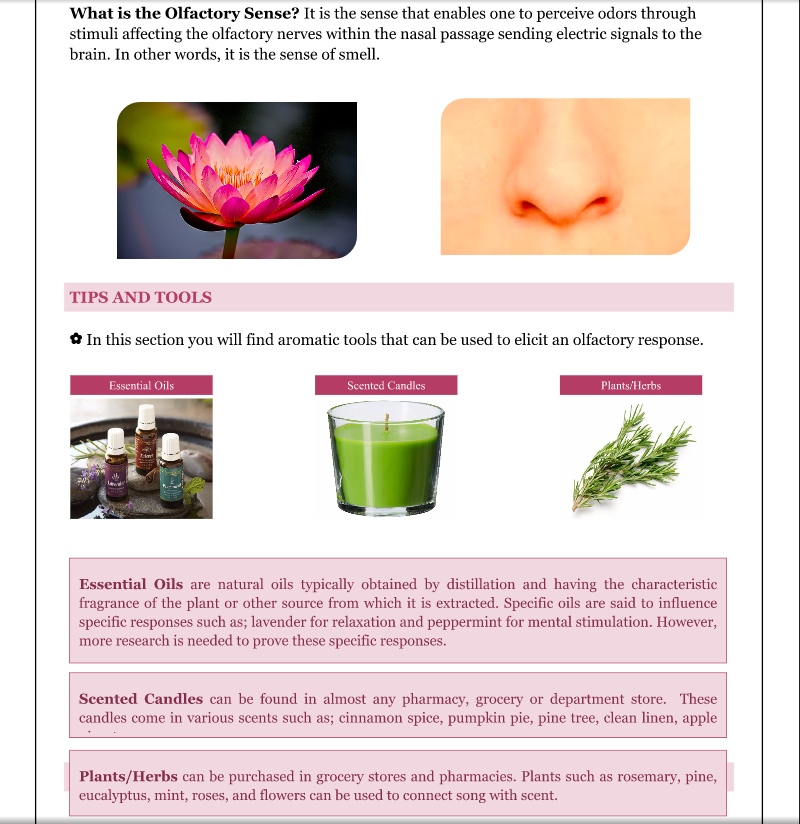
I recently completed my special project focusing on this NMT technique. I created a handbook for therapists including intervention ideas, song choices, instrument ideas and various materials to stimulate the senses. The intention of my handbook is to encourage therapists to feel confident in being able to stimulate arousal and recovery of wake states in individuals whom are high to severely low functioning or display a lack of arousal due to aging or disability. This arousal can be achieved by stimulating all of the human senses. The human body can be stimulated in ways, from sight, smell, taste, touch and hearing. As music therapists, we rely greatly on the use of music to promote significant responsiveness, however, we can creatively combine music with various mediums to create a holistic and engaging approach to awakening. The handbook is categorized by sense; touch, sight, smell, taste, and hearing, and for each sense tips and tools are provided to guide you in developing sensory based interventions that can be used to awaken each human sense in a gentle, inviting manor to awaken the life inside of all of us.

Here is a sneak peek showing some suggested ideas to utilize within MSOT.

Screen Shot 2016-07-17 at 5.53.09 PM

Happy awakening!

-Kristin

I recently completed my case study on the NMT technique Rhythmic Speech Cueing, also known as RSC. This technique was not a frequently used technique in my internship. It is used for speech and language rehabilitation. The techniques I have encountered most for speech and language training/rehabilitation are; Oral Motor and Respiratory Exercises (OMREX), Developmental Speech and Language Training through Music (DLSM), and Therapeutic Singing (TS).

What is Rhythmic Speech Cueing (RSC)? RSC is a rate-control technique that uses auditory rhythm- in metronome form or embedded in music-to cue speech.

How does it work? The impelling and anticipatory action of a rhythmic stimulus sequence can help initiate speech.

Who can benefit? RSC has been shown to be effective in fluency disorder rehabilitation for stuttering and cluttering.

Types of RSC: 

  1. Metric Cueing – Rhythmic beats are matched to syllables, resulting in speech inflection in which each syllable is of equal duration across and utterance. Metric cueing does not create normal time patterns of speech inflection.
  2. Patterned Cueing- uses beat patterns that stimulate stress patterns of normal speech inflection. The rhythm of speech synchronized to patterned cues is much closer to normal speech.

Exploring a new technique was very exciting and I found it to be incredibly useful for the particular individual involved in my case study. My case study results show that RSC is an effective NMT technique for childhood apraxia of speech. The patterned speech cueing used allowed for the client to decrease their rate of speech and providing the opportunity to increase their intelligibility of speech.


-Kristin

Back in March, I was given the opportunity to assist the MTCCA booth at the NFAR race. Families and professionals were approaching our booth and asking questions and this provided me with the opportunity to really learn about our company. Not only did I want to be able to thoroughly answer the questions of those who approached me but I also wanted to approach them and give them information. I was able to pick out the most important and useful information to share in a short amount of time in a language that families and professionals could understand.

260543_1224470927581492_1911096297671159704_n

What You Should Know About Your Internship Site

  1. The companies mission and philosophy
  2. The services that are offered
  3. The location of clinics
  4. The offered schedule
  5. The pricing and if covered by insurance

At The Music Therapy Center of California we believe that every person is capable of leading a happy, engaging and rewarding life. We offer individual and group music therapy sessions and we also offer adaptive lessons. We have two locations, one in Mission Valley and the second in Encinitas. We offer sessions Monday-Saturday. If you are interested in finding out if music therapy is the right fit for your child or loved one, we offer free 30 minute screenings.

[vimeo 108551478 w=640 h=360]
-Kristin

First of all, what is the vestibular sense? And where is it? Vestibular receptors are found in the inner ear, in the form of tiny hair cells. The vestibular system helps tell us when we’re up or down, moving or still, which direction we’re moving in, and how fast we’re going. When someone’s vestibular sense is out-of-sync, they may crave speed or be overly sensitive to it, they may be able to spin endlessly without getting dizzy or get motion sickness very easily, they may love dangling upside-down or be terrified of it, or they may not be able to tell if the train they are on is moving or if it’s the train next to theirs. An out-of-sync vestibular system, just like any other out-of-sync sense, likely leads to compensatory behaviors. Some of these may be harmful, disruptive, or not socially appropriate. Furthermore, they may interfere with the person’s ability to function smoothly in everyday life.

stock-photo-3791423-small-baby-boy-hanging-upside-down-on-white.jpg           What happens if one of your clients or your child has an out-of-sync vestibular system? They may be underesponsive or overesponsive to vestibular stimuli, or they may seek or crave vestibular stimulation. Any of these forms of sensory processing disorder can cause disturbance and frustration in their everyday functioning. Is the client terrified of moving/being moved? They may have an overesponsive vestibular system. Does the client not notice they are moving? They may have an underesponsive vestibular system. Does the child crave swaying, spinning, or being upside-down? They may be seeking more vestibular stimuli. The challenge arises in the fact that the child’s behaviors are not always so straightforward, and the category of sensory processing disorder under which their symptoms and behaviors fall may not be very clean cut. What I found most challenging is, how do you determine what sensory needs the child has and how to best address them?

spinning-child.jpg
The author of The Out-of-Sync Child, Carol Stock Kranowitz, recommends that parents or caregivers keep a diary of their child’s “troubling times,” noting the behavior, the date and time of day, and the circumstances. Parents and caregivers should also keep a diary of the child’s “terrific times,” again noting the behavior, date and time of day, and circumstances. This may help determine triggers for challenging behaviors and also the things or circumstances that lead to the child feeling in-sync. Matching the out-of-sync trigger with the in-sync antidote, can help parents, caregivers, and therapists determine which category of sensory processing disorder the child’s symptoms fall under, and how to provide the appropriate sensory diet and therapy for the child. I am challenging myself to keep track, in a similar way, of “troubling times” and “terrific times” in my some of my clients who have sensory processing needs, in order to better track cause-effect-solution patterns. In doing so, I hope to understand better what I can do to help their senses feel in-sync.

To better understand sensory processing disorders (SPD), or if you suspect your child, a client, or someone you know may have SPD, I highly recommend reading The Out-of-Sync Child by Carol Stock Kranowitz.

– Chiara